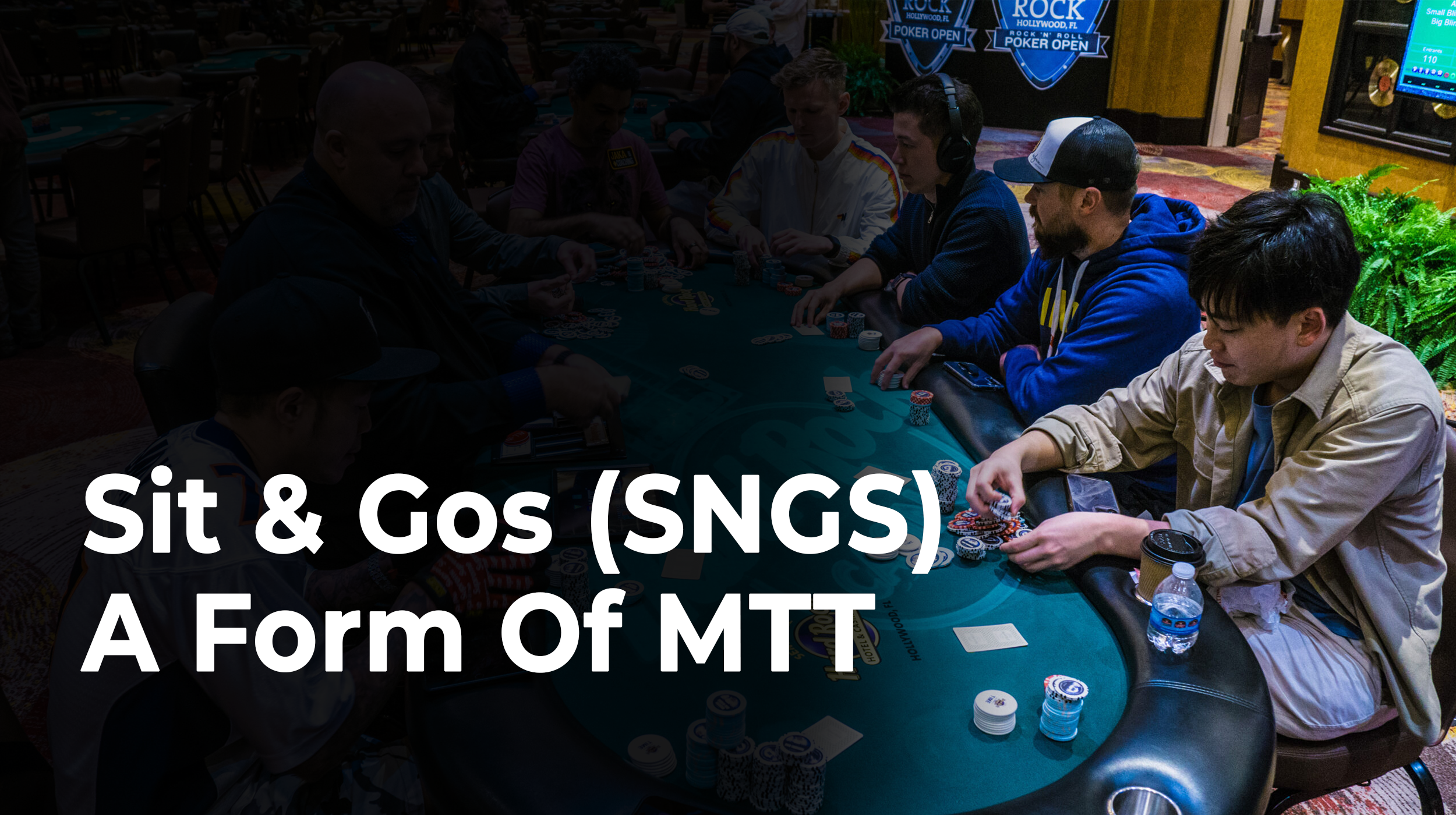
A Sit & Go (SNG) is a tournament that starts as soon as the required number of players have registered. There is no scheduled start time: you sit, and the game goes when the seats are full. SNGs typically run with 6, 9, or 18 players and finish in 45 minutes to two hours.
Why SNGs Are Great for Beginners
Fixed, short duration. You know roughly how long the session will last. No all-day commitments.
Predictable structure. The same blind levels, the same field size, the same payout shape every time. You can master one format completely before moving on.
Condensed ICM practice. The three-prize structure forces you to experience bubble pressure and final-table decisions quickly and repeatedly, building instincts that transfer to larger tournaments.
Lower variance than large MTTs. With a small field, a skilled player reaches the money frequently enough to see meaningful results within a reasonable sample.
Standard Payout Structure
For a 9-player SNG, the typical payout:
| Finish | Payout |
|---|---|
| 1st | 50% of prize pool |
| 2nd | 30% |
| 3rd | 20% |
The top three cash; six players receive nothing. Every decision from four-handed onwards is influenced by this payout shape.
The Three Stages of a SNG
Early Stage (9 to 6 players, 20+ BB)
Play tight and avoid large confrontations. The blinds are small relative to your stack and the money is too far away to justify high-risk plays. Pick up small pots with position and strong hands. Avoid flipping for your stack.
Middle Stage (5 to 4 players, 10 to 20 BB)
The average aggression increases as there are less players and you have to play more hands. Players are one bust away from the money and stakcs are dwindling, it's critical to steal small pots and blinds when you can. Look to exploit players that over-tighten dramatically near the bubble.
Bubble and Money (4 to 3 players)
When playing four-handed and approaching the bubble, you should use your big stack to shove light against the short stacks. You should generally avoid confrontations with other big stacks unless you are holding a premium hand.
Once you reach the money with three players remaining, your goal shifts because first place pays significantly more than third. Rather than playing passively to lock up a min-cash, you should accumulate chips aggressively and play for the win.
Heads Up
Many SNGs finish with a heads-up battle for first place. Heads-up play is dramatically different from full-ring: nearly every hand goes to the flop, and hand values shift significantly. A pair of twos is a strong hand. Any ace is a big hand.
If heads-up play is a weakness, study it separately or play dedicated heads-up SNGs at low stakes.
SNG Formats
| Format | Players | Approx. duration |
|---|---|---|
| 9-max | 9 | 60 to 90 min |
| 6-max | 6 | 30 to 60 min |
| Heads Up | 2 | 15 to 30 min |
| Turbo | 9 | 30 to 45 min |
| Hyper-Turbo | 9 | 15 to 20 min |
Turbo and hyper-turbo formats use faster blind structures, creating push-fold situations earlier. They compress the skill expression window but are popular for volume.
Using the ICM Calculator
The three-prize structure makes ICM straightforward to visualize. Use the ICM calculator with three payout spots to see how a chip lead translates into money equity and understand why preserving your stack is often more valuable than chip EV suggests.

Written by
PokerTournaments101
25 years playing mid-to-high stakes NLH and PLO across live and online. Poker industry veterans turned tournament grinders, tool builders, and writers.
GETTING STARTED
Game Formats