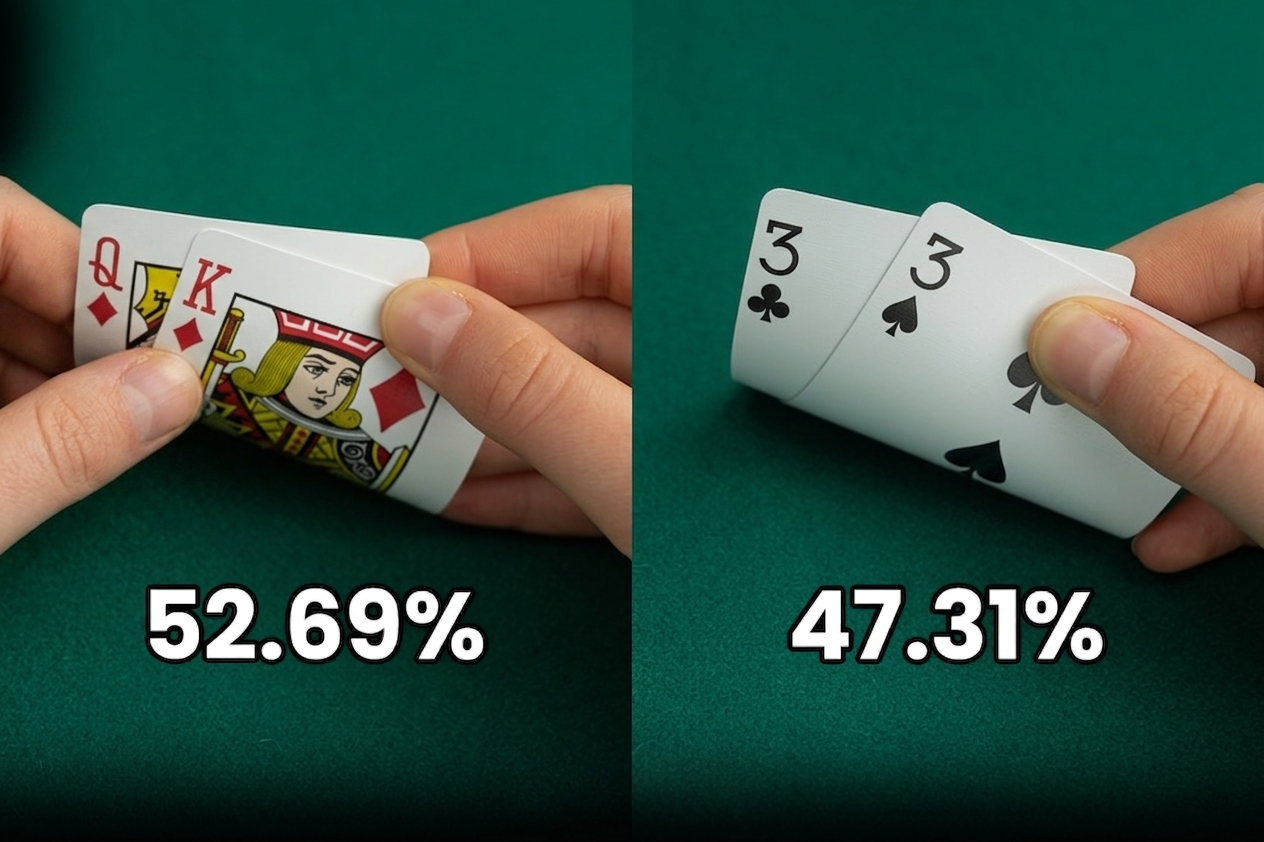
Every time you are behind in a hand but still have a chance to improve, you need two numbers: how many outs you have, and what equity those outs give you. With these two numbers and a simple formula, you can make accurate calling decisions in seconds.
What Are Outs?
An out is any card remaining in the deck that will make your hand the likely winner. If you have a flush draw and there are nine hearts left in the deck, you have nine outs.
Counting Outs
Flush Draw
You hold A♥7♥ and the board is K♥9♥3♦.
Nine hearts remain in the deck (13 total minus 2 in your hand minus 2 on the board). You have 9 outs.
Open-Ended Straight Draw
You hold 8♠9♣ and the board is 6♥7♦K♠.
Any five or any ten completes your straight. That is four fives and four tens: 8 outs.
Gutshot Straight Draw
You hold J♥9♣ and the board is 8♠7♦2♥.
Only a ten completes the straight. 4 outs.
Overcards
You hold A♥K♦ and your opponent holds a pair. If no ace or king is on the board, you have six outs to make top pair (3 remaining aces plus 3 remaining kings). These are not always clean outs since top pair may not be the best hand.
The Rule of 2 and 4
The fastest way to convert outs to equity without a calculator:
- On the flop (two cards to come): multiply outs by 4
- On the turn (one card to come): multiply outs by 2
| Outs | Flop equity (x4) | Turn equity (x2) |
|---|---|---|
| 4 (gutshot) | ~16% | ~8% |
| 8 (OESD) | ~32% | ~16% |
| 9 (flush draw) | ~36% | ~18% |
| 15 (flush + OESD) | ~60% | ~30% |
These are approximations but accurate enough for in-game decisions.
Combining Outs with Pot Odds
Knowing your equity only matters if you compare it to the price you are being charged to continue. That price is your pot odds.
If the pot is $100 and your opponent bets $50, you need 25% equity to call profitably. A flush draw on the flop gives you roughly 36%. Clear call.
If your equity exceeds the required equity, calling is profitable long-term. If it does not, fold.
See Understanding Pot Odds for the full formula, and use the equity calculator to check exact numbers for any hand matchup.
Discounting Outs
Not all outs are clean. If making your straight also puts a flush on the board, some of your outs may complete your hand while losing to a better hand.
- Full outs: outs that almost certainly give you the best hand
- Half outs: outs that might give you the best hand but carry real risk
A flush draw on a paired board, where your opponent could already have a full house, might effectively give you only 6 or 7 clean outs rather than 9. Discount when the risk is genuine.
FAQ
What if I have two draws at once, like a flush draw and a straight draw? Count the outs for each, but subtract any overlap. A flush draw (9 outs) combined with an open-ended straight draw (8 outs) does not always give 17 outs, because some straight-completing cards may also complete the flush. Count carefully to avoid double-counting.
Are outs the same as winning chances? Not exactly. An out is a card that improves your hand, but the improved hand still needs to be the best hand. Always sanity-check: if you hit your flush, can your opponent have a full house? If so, those outs may be partial or worthless.
How do I count outs when I don't know my opponent's hand? You estimate based on their range. If your opponent's range includes many strong hands, your outs against those hands may be limited. Against a pure bluff, you may already be ahead and have no need for outs at all.
Common Mistakes
Counting outs that do not win. Beginners count cards that improve their hand without checking whether the improved hand actually beats the opponent. A flush draw on a paired board against an opponent betting for value may give you far fewer effective outs than nine.
Applying the rule of 2 and 4 on the wrong street. The rule of 4 applies on the flop when two cards remain. Using it on the turn overstates your equity by roughly double. Always use the rule of 2 on the turn.
Forgetting to discount. Treating all outs as clean overestimates equity in many real situations. When the board is wet or your opponent's range is strong, some outs are dangerous.
Counting outs without knowing the pot odds. Outs alone tell you nothing. The number only becomes useful when compared to the price you are paying to see the next card. Always pair your out count with a pot odds calculation before calling.

Written by
PokerTournaments101
25 years playing mid-to-high stakes NLH and PLO across live and online. Poker industry veterans turned tournament grinders, tool builders, and writers.