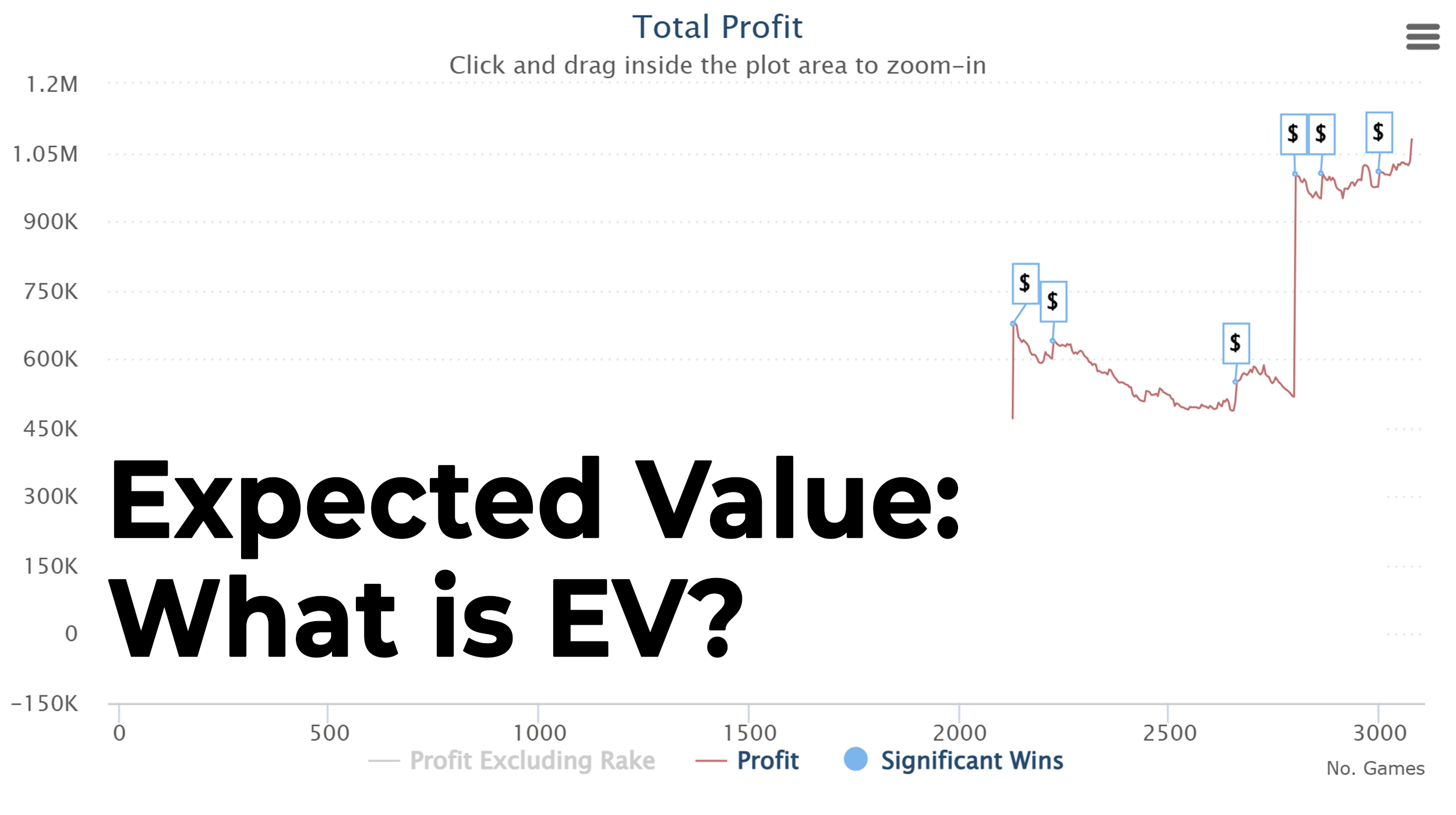
Every decision at the poker table has a long-run average outcome. That average is its expected value, or EV. Making +EV decisions consistently is what separates winning players from losing ones over time.
What EV Means
EV is the average amount you win or lose on a decision if you made it thousands of times. A single outcome can be lucky or unlucky. Over a large enough sample, luck averages out and only the quality of your decisions determines your results.
- +EV: The decision makes money on average. Make these.
- -EV: The decision loses money on average. Avoid these.
- 0 EV: The decision breaks even. Indifferent between the options.
A Basic EV Calculation
EV = (Probability of winning x Amount won) + (Probability of losing x Amount lost)
Example: an all-in on the river
The pot is $200.
Your opponent bets $100 .
You must call $100 to win $300 total.
You estimate your hand A♠2♠ wins 45% of the time. On this board:
River ($200): 4♠6♣4♥2♦3♣
EV of calling = (0.45 x $300) + (0.55 x -$100) EV of calling = $135 - $55 = +$80
You expect to net $80 on average every time you make this call. So the correct move is to all.
EV in a Bet-or-Check Spot
Suppose you are on the river with the nuts a King high straight K♠Q♠. You can check (gaining $0 extra) or bet $50 into a $100 pot.
River ($100): 9♠5♣J♥2♦T♣
Your opponent calls 40% of the time and folds 60%.
EV of betting = (0.40 x $50) + (0.60 x $0) = +$20 extra
Betting adds $20 in expected value compared to checking. The correct decision is to bet.
Why Results Are Not the Same as EV
You can make a +EV decision and still lose. You can make a -EV decision and still win. A single hand tells you almost nothing about whether you played correctly. This is variance.
Getting your money in as a 70% favourite and losing is called a bad beat. You played correctly. The loss does not change the quality of the decision.
A hand like A♠A♣ has ~80% equity against 2♥2♦. That still means you will lose 1 out of 5 times.
Evaluate decisions by the information available at the time of the decision, not by the outcome. This mindset is the foundation of improving as a player.
Chip EV vs Real-Money EV in Tournaments
In cash games, chips equal real money. A chip is a chip.
In tournaments, chip EV and real-money EV diverge. Winning a large pot does not gain you as much real money as losing the same pot costs you, because of the payout structure. This is the basis of ICM.
A spot that is +chip EV can be -money EV near the bubble or final table. Always consider the tournament context when making large decisions.
See ICM Explained and use the ICM calculator to see how stack changes translate into real-money equity.
Making Better Decisions
- Use pot odds and the equity calculator to estimate EV on calling decisions
- Think long-run: one session or one hand is never enough data. Focus on making +EV plays repeatedly and results will follow.
- When a decision feels right but you cannot explain why numerically, work through the EV calculation. Intuition and math should point the same direction.
FAQ
If I always make +EV decisions, will I always win? In the long run, yes. In the short run, variance means even correct decisions lose. A 70% favourite loses 30% of the time. Over thousands of hands, +EV decisions produce positive results, but individual sessions and even months can show a loss despite correct play.
How do I estimate probabilities in real time? For calling decisions, use pot odds combined with the rule of 2 and 4 to estimate your equity quickly. For more complex bet-or-bluff decisions, you are estimating how often your opponent folds or calls based on their tendencies. Exact math is for study; approximation is for the table.
Does EV apply to bluffs? Yes. A bluff has positive EV when your opponent folds often enough relative to the amount you risk. If you bet $50 into a $100 pot, your opponent needs to fold more than 33% of the time for the bluff to be +EV. EV applies to every decision, including folds, checks, bets, and raises.
What is the difference between EV and equity? Equity is your share of the pot in percentage terms (how often you win). EV is the dollar amount that share translates to after accounting for the amounts involved. Equity tells you your probability. EV tells you the financial outcome.
Common Mistakes
Judging decisions by their outcome. The most damaging mistake in poker thinking. A bad call that gets lucky is still a bad call. A good fold that would have won is still a good fold. Outcome-based thinking reinforces the wrong habits and stalls improvement.
Confusing chip EV with money EV in tournaments. Near the bubble and at the final table, taking a marginal +chip EV flip can be a significant money EV mistake. ICM pressure changes the calculation substantially. Always factor in tournament context.
Rounding probabilities too generously. Estimating "I win about 50%" when the honest estimate is closer to 35% turns a -EV call into a perceived +EV one. Overconfidence in your equity is one of the most common sources of losing calls.
Not considering the EV of folding. Folding has an EV of zero chips in the current pot, which is often the correct comparison point. When a call is marginally negative EV, folding and preserving chips has real value, especially in tournaments.

Written by
PokerTournaments101
25 years playing mid-to-high stakes NLH and PLO across live and online. Poker industry veterans turned tournament grinders, tool builders, and writers.