Position in poker means where you act relative to the dealer button. Act later and you see what everyone does before you decide. Act earlier and you are making decisions with less information. Over millions of hands, position is one of the largest drivers of win rate.
The Dealer Button
The button (BTN) is a disc that marks who acts last on every post-flop betting round. After each hand it moves one seat clockwise. The two players immediately left of the button post forced bets: the small blind (SB) and big blind (BB).
Seat Names at a 9-Max Table
| Position | Abbreviation | Acts preflop |
|---|---|---|
| Under the Gun | UTG | 1st |
| UTG+1 | UTG+1 | 2nd |
| UTG+2 | UTG+2 | 3rd |
| Lojack | LJ | 4th |
| Hijack | HJ | 5th |
| Cutoff | CO | 6th |
| Button | BTN | 7th (last preflop) |
| Small Blind | SB | 8th preflop, 1st post-flop |
| Big Blind | BB | 9th preflop, 2nd post-flop |
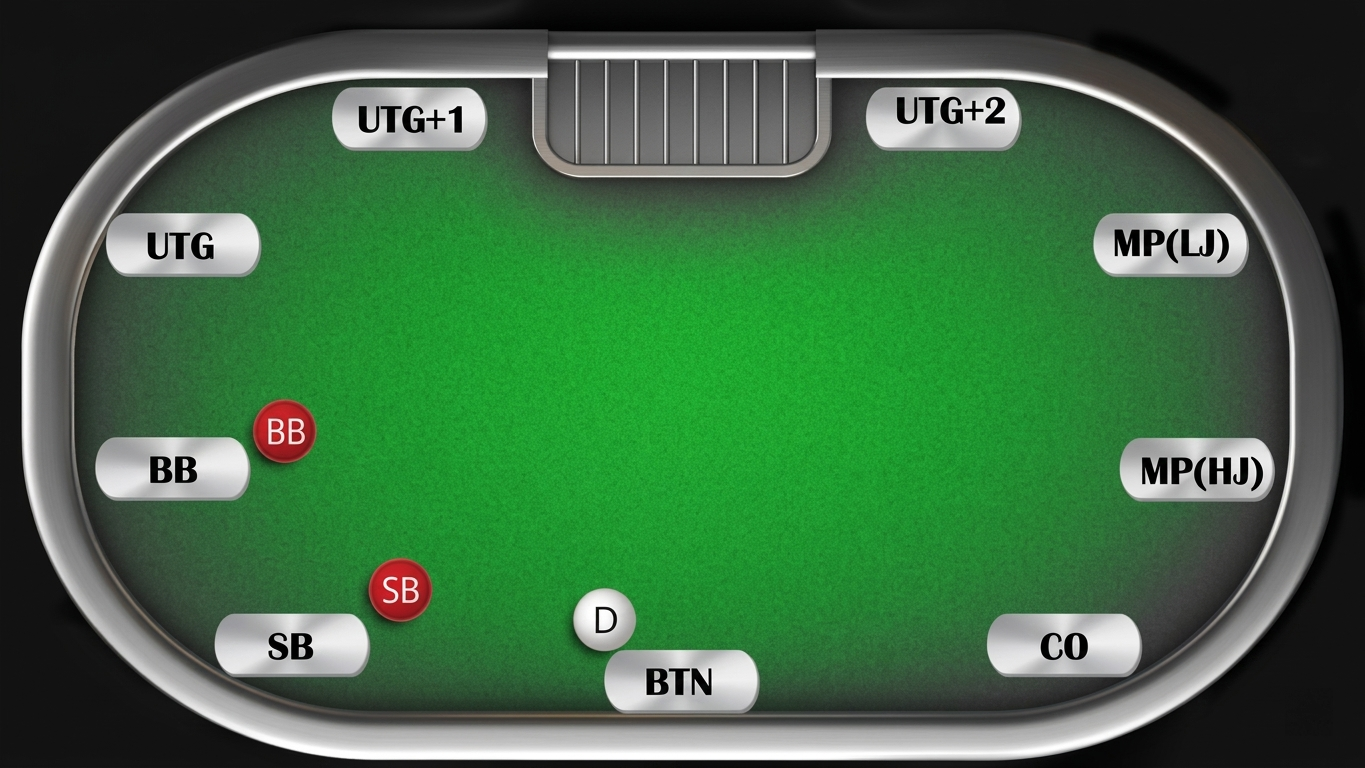
Post-flop, the small blind acts first and the button acts last for every street.
Early Position (UTG through UTG+2)
You act before most of the table and have no information about what anyone will do. Play tight here: open only strong hands, fold speculative ones. A hand that plays profitably from the button may be a clear fold from UTG.
Middle Position (LJ and HJ)
A moderate amount of information. You know early players have either folded or shown strength. You can open a wider range than early position, but you still face action from the cutoff, button, and the blinds.
Late Position: Cutoff and Button
The cutoff and button are the most profitable seats. You act after most players and have the most information available. The button is the best seat in poker: you see every post-flop action last for the entire hand, on every street.
From the button, open a wide range of hands. You will have a structural edge over every opponent you face in the hand.
The Blinds
The small blind and big blind are the worst positions post-flop. Despite posting forced bets that give them a slight price reduction preflop, they act first on every post-flop street.
The goal in the blinds is to lose money at a slower rate, not to win. Defend selectively and accept that both blind positions are structural losses in the long run.
A Practical Example
A hand like 6♠5♠ plays well from the button. You have position, two playable cards, and can see how opponents act before you commit chips. From UTG at a full table, the same hand is a fold: you will face 8 opponents who may have stronger holdings, and you will be out of position against whoever calls.
Using Position
- Widen your opening range as you move toward the button
- Narrow your calling range when out of position
- Use position to control pot size post-flop: check back in position to keep the pot small with marginal hands, or bet to build it with strong ones
Use the range viewer to see specific hand recommendations for each seat.
FAQ
Does position change every hand? Yes. The button moves one seat clockwise after each hand, so every player cycles through every position. Over a full orbit you will pay the small and big blind once each and play every other seat once.
What does "in position" and "out of position" mean? You are in position when you act after your opponent on post-flop streets. Out of position means you act before them. Being in position is a significant advantage because you have more information before each decision.
Can I play any hand from the button? No, but you can play a much wider range than from early position. Even from the button there are hands too weak to open profitably, especially when facing a raise. The button advantage is structural, not unlimited.
Why do the blinds lose money long-term even though they have chips invested? The forced bet gives a price reduction preflop, but acting first post-flop on every street costs more in lost value than the discount saves. Over enough hands the blind positions are net losers for everyone.
Common Mistakes
Playing too many hands from early position. Beginners often play the same range regardless of seat. UTG requires a tighter range than any other seat because you face the most opponents and have no post-flop position.
Forgetting that blind position is the worst post-flop. The big blind may have the best preflop price, but the structural disadvantage of always acting first post-flop outweighs it. Avoid bloating the pot in the blinds with marginal hands.
Not widening enough from the button. The flip side of the above: many beginners play too tight from the most profitable seat. The button is where steal raises, speculative calls, and light 3-bets are most profitable.
Ignoring position when deciding whether to call a raise. Calling a raise out of position with a marginal hand is a common leak. The hand you are calling with needs to be stronger when you will act first on every post-flop street.
Key Takeaway
Position provides an informational advantage. When you get to see what everyone will do first, you get more information on the strength of their hand.

Written by
PokerTournaments101
25 years playing mid-to-high stakes NLH and PLO across live and online. Poker industry veterans turned tournament grinders, tool builders, and writers.
GETTING STARTED
The Rules