Texas Hold'em is the most played form of poker in the world. Every major tournament series, from the World Series of Poker to the WPT, runs on it. Learning the rules takes about ten minutes. Getting good takes a lifetime. This guide covers the first part.
The Goal
Each hand is a competition for the pot, the pile of chips in the center of the table. You win the pot in one of two ways:
- Best hand at showdown: when all betting is done, the player with the strongest five-card hand takes the pot.
- Last player standing: if everyone else folds, you win the pot immediately with no cards shown.
In a tournament, losing all your chips means elimination. In a cash game, you can rebuy at any time. The hand rules are identical in both formats.
The Table Setup
A standard Texas Hold'em table seats 2 to 9 players. Before every hand, two things are established:
The dealer button (BTN): a small disc marking the nominal dealer. The button moves one seat clockwise after each hand. The player on the button acts last after the flop, which is a significant advantage.
The blinds: the two players immediately left of the button post forced bets before any cards are dealt.
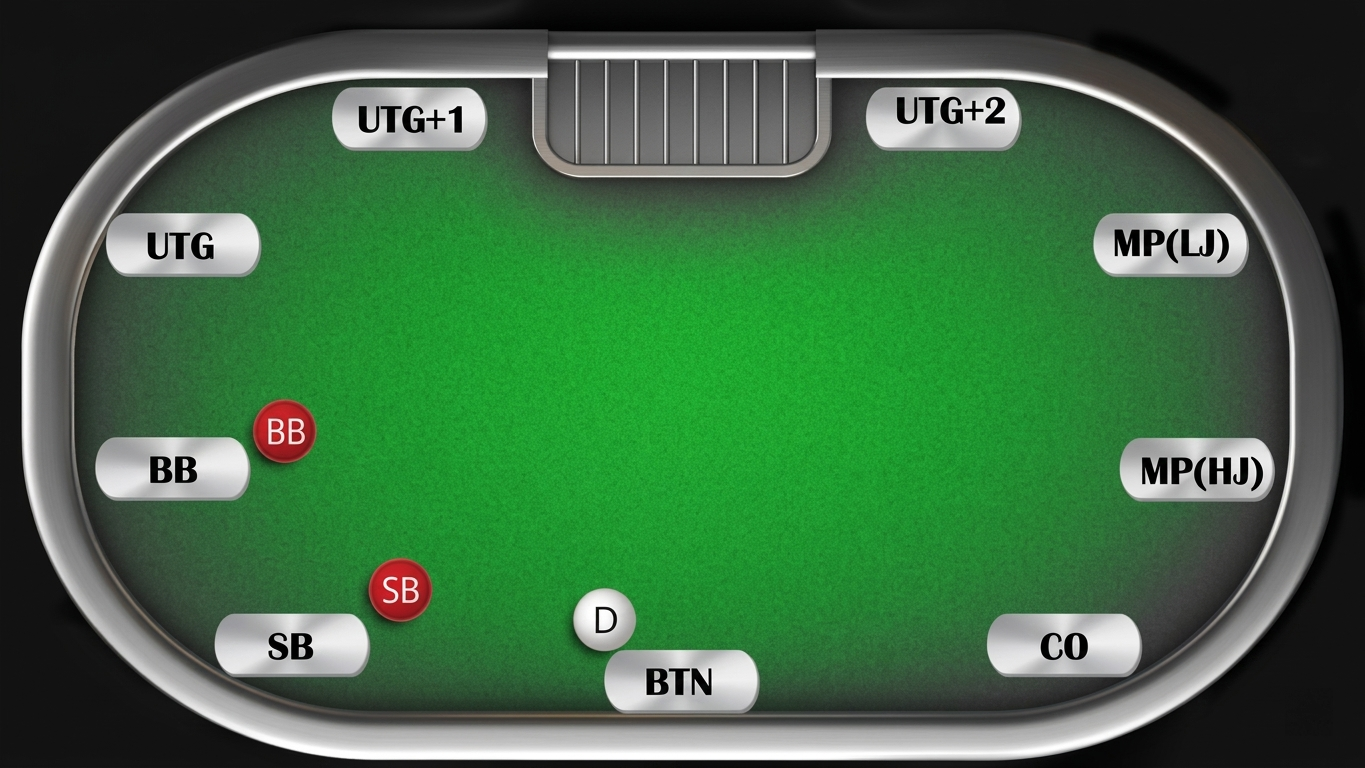
- Small blind (SB): the player directly left of the button posts a smaller forced bet, for example $1.
- Big blind (BB): the next player posts a larger forced bet, typically double the small blind, for example $2.
Blinds seed the pot so there is always something to play for on every hand.
Dealing the Cards
Each player receives two private hole cards, dealt face down. Only you see your own hole cards.
Separately, the dealer places five community cards face up in the center of the table over the course of the hand. Every player at the table can use these community cards to build their best hand.
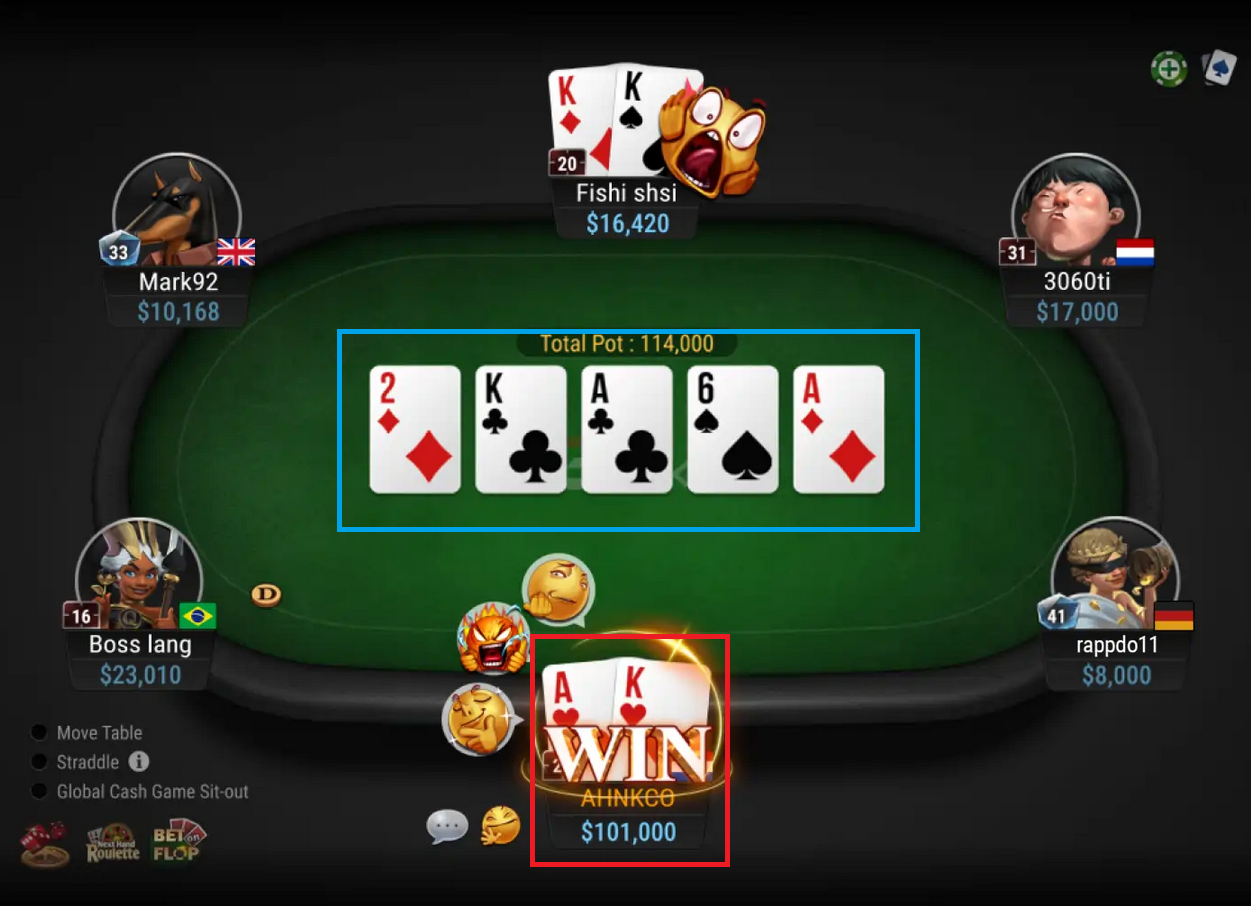
The player's two private hole cards (in red) and the five community cards (in blue).
Your final hand is always the best five-card combination from any combination of your two hole cards and the five community cards. In the above example it would be A♥A♣A♦K♥K♣ You can use both hole cards, one, or even none if the board alone makes a better hand.
The Four Betting Rounds
A hand of Texas Hold'em has up to four betting rounds. Action moves clockwise around the table. On each turn, a player can:
| Action | When available | What it means |
|---|---|---|
| Check | No bet is facing you | Pass the action without putting in chips |
| Bet | No bet has been made yet | Open the betting by putting in chips |
| Call | A bet is facing you | Match the bet to stay in the hand |
| Raise | A bet is facing you | Increase the bet; opponents must call the new amount |
| Fold | On your turn | Discard your hand and forfeit your claim to the pot |
If every player except one folds at any point, the last remaining player wins the pot immediately without a showdown.
Round 1: Preflop
After hole cards are dealt, the first betting round begins. The player immediately left of the big blind acts first and play proceeds clockwise.
The big blind has a special option: if no one has raised, the BB may check (stay in for free) or raise. This is called the option.
Common preflop actions:
- Fold: discard your hand, you are done with this hand.
- Call: match the big blind to stay in.
- Raise: increase the bet, usually to 2.5x to 3x the big blind.
Round 2: The Flop
After preflop betting ends, the dealer burns one card and places three community cards face up. This is the flop.
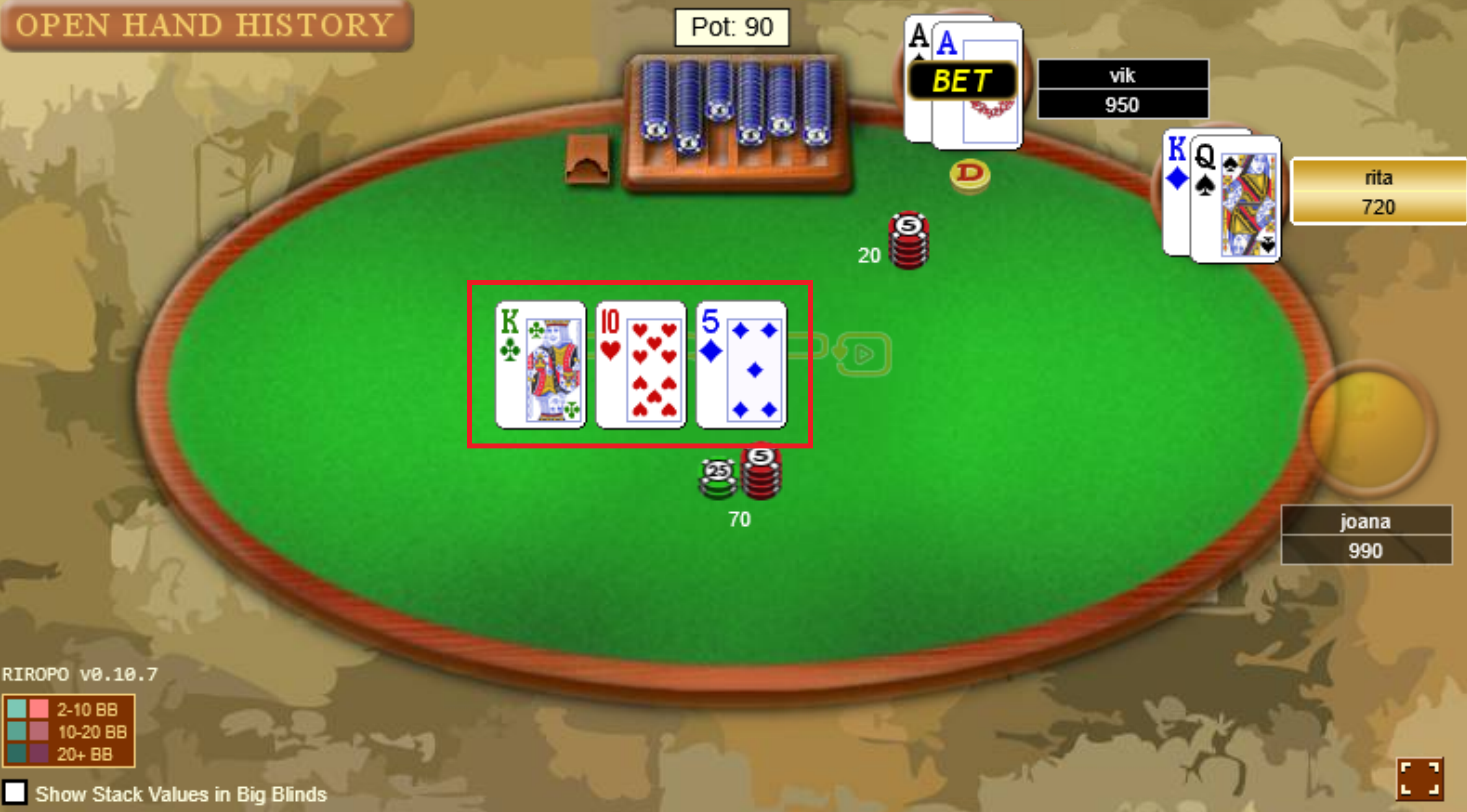
The flop comes out K♣T♥5♦ (in red).
A second round of betting follows. Now the player immediately left of the button acts first (the small blind if still in, or the next active player).
Round 3: The Turn
The dealer burns a card and places a fourth community card face up. This is the turn, also called fourth street.
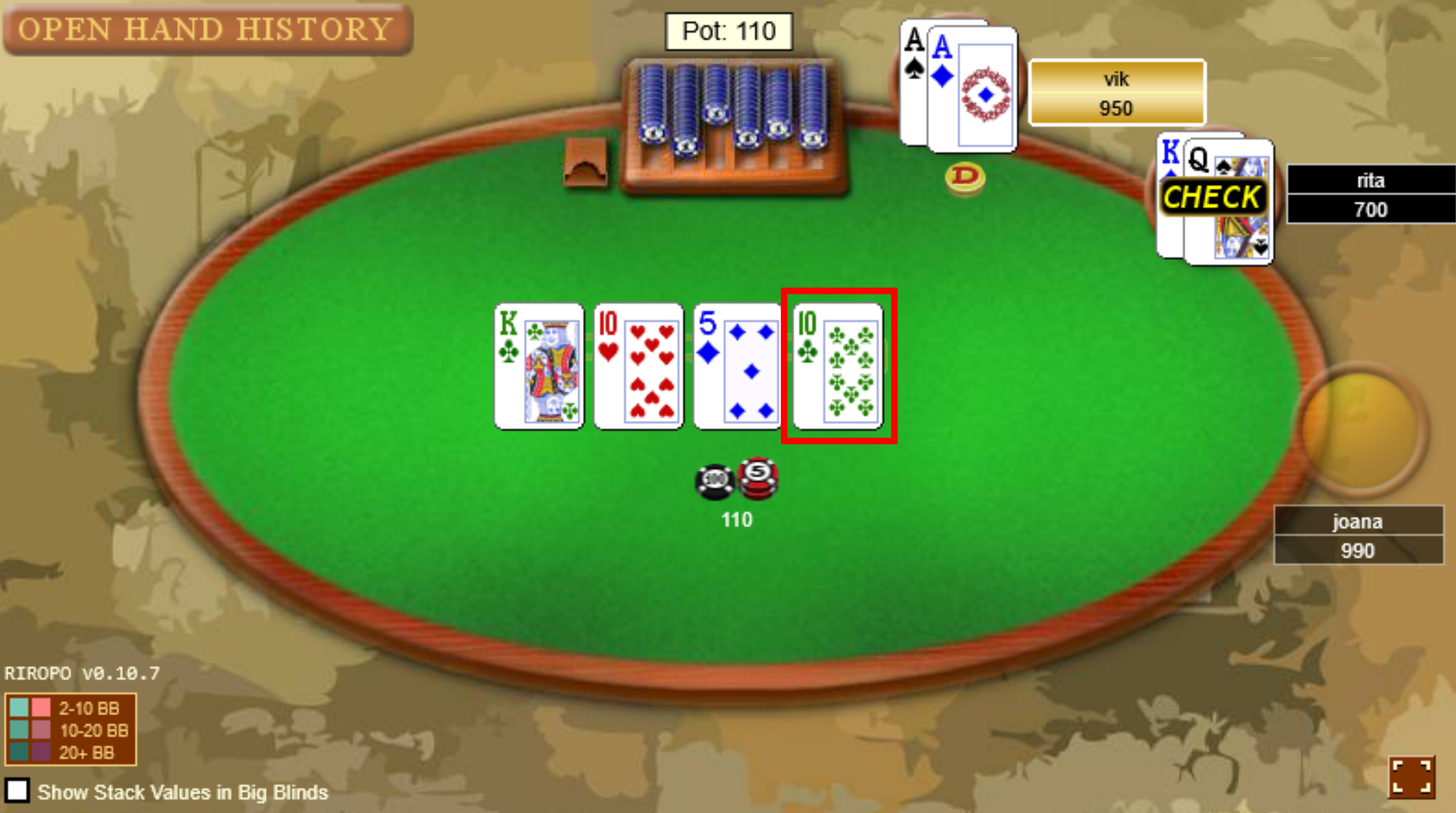
The turn comes out as a T♣ (in red).
A third betting round follows with the same order of action.
Round 4: The River
The dealer places the fifth and final community card face up. This is the river, also called fifth street.
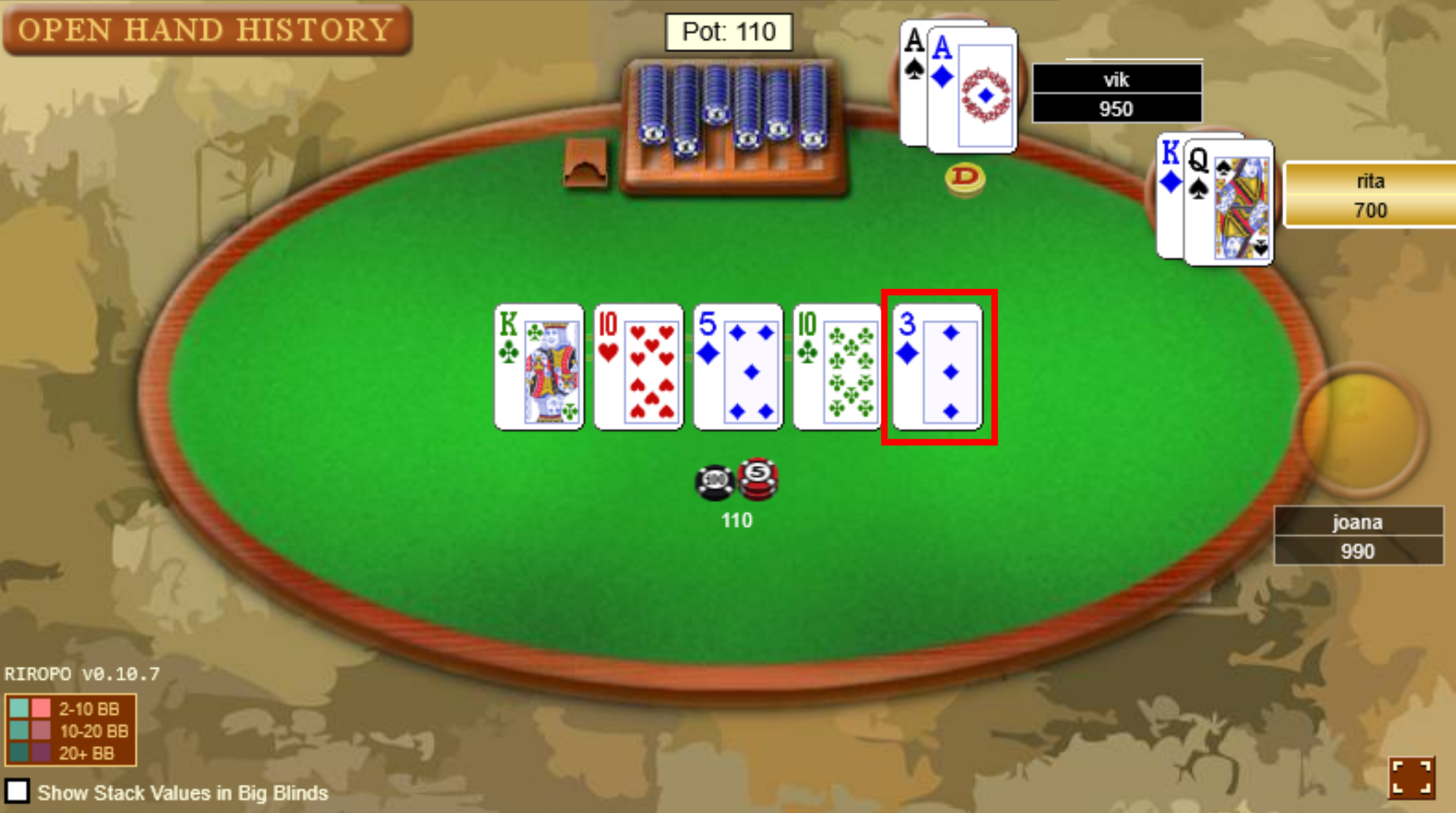
The river comes out as a 3♦ (in red).
The final betting round takes place. If two or more players remain after all betting is complete, the hand goes to showdown.
Showdown
At showdown, remaining players reveal their hole cards. The player with the best five-card hand wins the pot. If two or more players have identical five-card hands, the pot is split evenly between them.
The player who made the last aggressive action (the last bet or raise) on the river shows first. Other players can choose to show or muck (discard without showing) their cards.
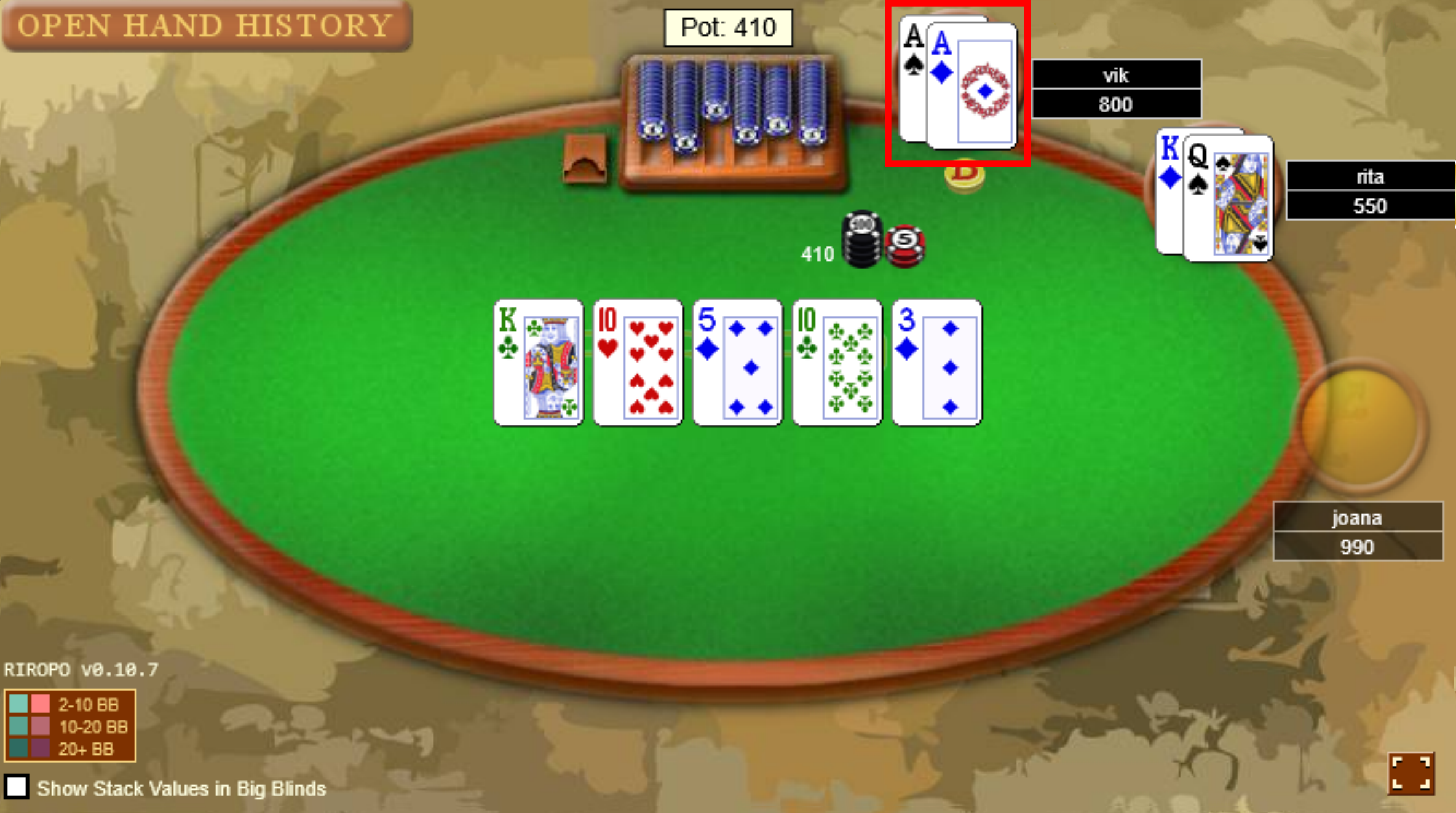
vik wins the hand with two pair Aces and Tens with a King kicker vs rita's two pair Kings and Tens with a Queen kicker.
Hand Rankings (Best to Worst)
| Rank | Hand | Example |
|---|---|---|
| 1 | Royal Flush | A♦K♦Q♦J♦T♦ |
| 2 | Straight Flush | 9♣8♣7♣6♣5♣ |
| 3 | Four of a Kind | A♠A♥A♦A♣K♦ |
| 4 | Full House | K♠K♥K♦T♣T♦ |
| 5 | Flush | A♥J♥8♥5♥2♥ |
| 6 | Straight | 9♠8♦7♥6♣5♦ |
| 7 | Three of a Kind | Q♠Q♥Q♦A♣7♦ |
| 8 | Two Pair | A♠A♦K♥K♣Q♦ |
| 9 | One Pair | J♠J♣A♦K♥7♣ |
| 10 | High Card | A♠J♣8♦5♥2♣ |
See the full hand rankings article for examples, tie-breaker rules, and edge cases.
All-In and Side Pots
If you do not have enough chips to call a full bet, you can go all-in: put in everything you have. You remain eligible to win only the portion of the pot you contributed to.
When multiple players are all-in for different amounts, the dealer creates side pots. Each side pot is contested only by the players who contributed chips to it. The main pot is split separately.
A Full Hand, Step by Step
The following hand takes place at a $25/$50 tournament table 100bb effective. Hero sits on the Button.
Preflop
Preflop (1.5bb posted): Hero is dealt K♠Q♠ on the Button. UTG folds. CO raises to 2.5bb. Hero calls. Small Blind folds. Big Blind calls. Three players see the flop.
Flop
Flop (7.5bb): J♠T♣4♥
Big Blind checks. CO bets 4bb. Hero calls. Big Blind folds.
Hero has an open-ended straight draw: any Ace or Nine completes a straight.
Turn
Turn (15.5bb): J♠T♣4♥A♦
CO checks. Hero bets 10bb. CO calls.
The A♦ completes Hero's straight. K♠Q♠ on a board of J♠T♣4♥A♦ makes A-K-Q-J-T, the highest possible straight and the current nuts. Hero bets for value.
River
River (35.5bb): J♠T♣4♥A♦3♣
CO checks. Hero bets 20bb. CO calls. Hero wins with K♠Q♠ (straight, ace high).
Tournaments vs Cash Games
The rules above apply to both formats, but the context changes:
- Cash games: chips are worth their face value. You can leave and cash out anytime.
- Tournaments: chips have no cash value directly. You compete for prize money based on finishing position. Blinds rise every level, creating urgency. Lose all your chips and you are eliminated.
Our ICM explained article explains why tournament strategy diverges significantly from cash game strategy as the final table approaches.
What to Learn Next
Now that you know how a hand works, build your foundation with these:
- Hand Rankings: which hands beat which, with examples
- Table Positions: why where you sit changes every decision
- Pot Odds: the math behind every call decision
- Preflop Ranges: which hands to play from each seat

Written by
PokerTournaments101
25 years playing mid-to-high stakes NLH and PLO across live and online. Poker industry veterans turned tournament grinders, tool builders, and writers.
GETTING STARTED
The Rules