Live tournament poker is a different game from online. The field is weaker, the pace is slower, and the dynamics at the table are far more personal. All three of those facts create opportunities, and all three create traps for players who do not handle them correctly. The adjustments that separate a strong live player from an online grinder are not just about ranges. They are about reading people, managing your own psychology, and staying sharp for eight hours when a phone is sitting right there in your pocket.
Theory First, Exploits Second
The first and most important principle of live adjustments: theory is still your baseline. This sounds obvious but gets violated constantly, often by players who convince themselves they are exploiting when they are actually just playing without a framework.
Live fields are weaker than online. That is simply true. Players open too wide, call too much, do not defend their blinds correctly, and fold too often on scary boards. Those tendencies create real opportunities to open slightly wider from all positions, bluff with higher frequency on boards where players over-fold, and barrel more aggressively on turns and rivers against players who will not look you up.
The key word is slightly. We do not go from a theoretically correct range to something random because we have decided the table is weak. That is what bad tournament players do. Good players know their default ranges cold, then identify specific adjustments and the reasons for those adjustments. We widen our UTG open from roughly 18.6% to 24.5% because the average player at this table is not going to three-bet us or punish our positional disadvantage aggressively. We barrel the turn with a semi-bluff because the specific player in the BB has been over-folding to aggression. We have reasons. We are not just playing differently because it feels like the right environment for it.
One trap that deserves specific attention: using exploits as an excuse to over-fold. This is extremely common in live tournaments. We observe that a player rarely bluffs, convince ourselves we are making a smart exploit by folding, and end up folding at far below the theoretically correct frequency. If theory says we need to defend 50% of our range in a given spot, we do not fold 80% of it because we have a read that the villain bluffs infrequently. We might defend 45%. We are making a slight adjustment in one direction, not abandoning the framework entirely.
| Situation | Theory Baseline | Live Adjustment Range |
|---|---|---|
| UTG open range | ~18.6%% | ~24.5% vs passive field |
| C-bet frequency on dry boards | ~60-70% | ~70-80% vs over-folders |
| Calling range vs aggression | Solver frequency | -5% to -10% vs tight ranges |
| River bluff frequency | Balanced | +5% to +10% vs players who over-fold rivers |
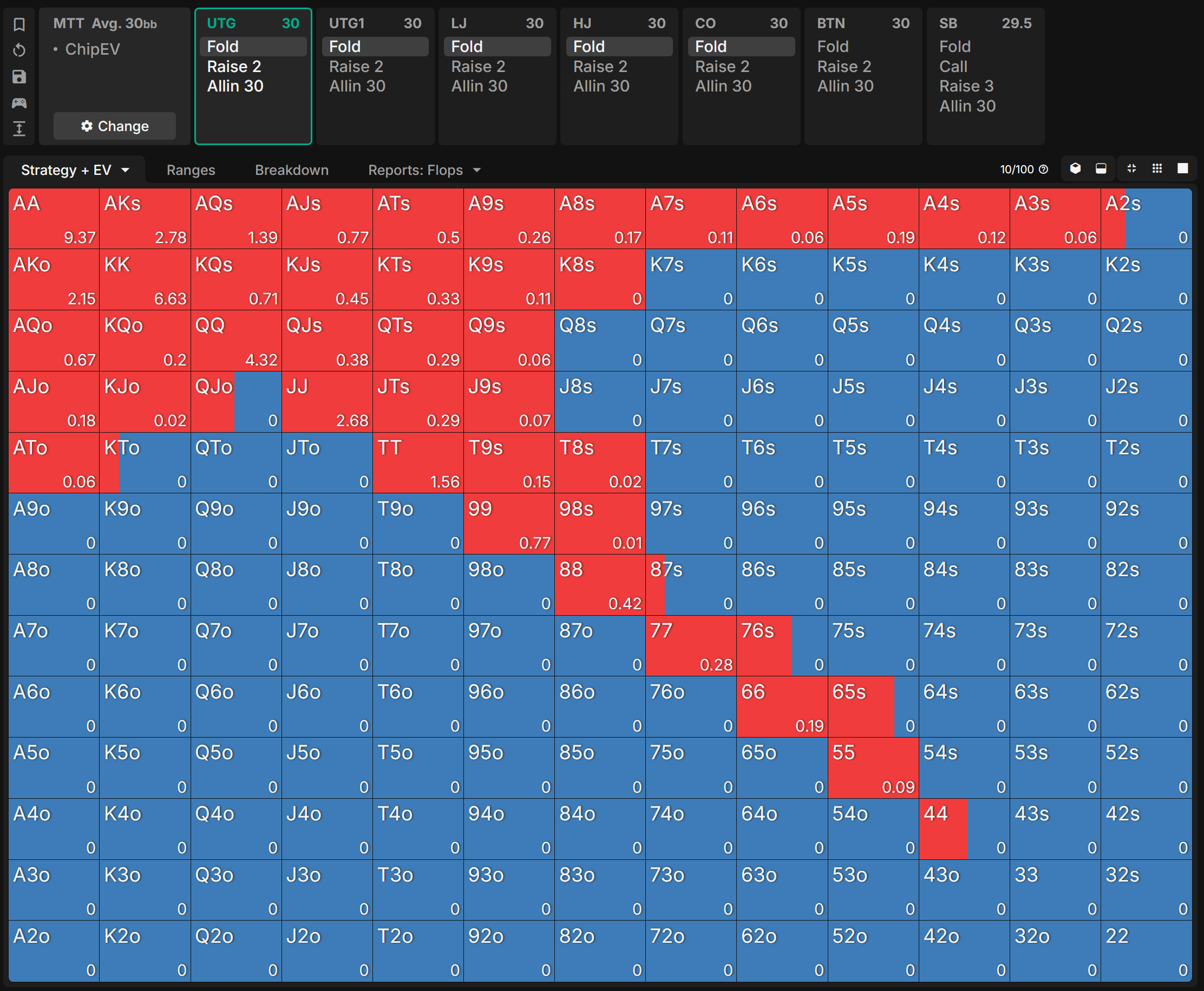
Baseline UTG open range used as the theory starting point.
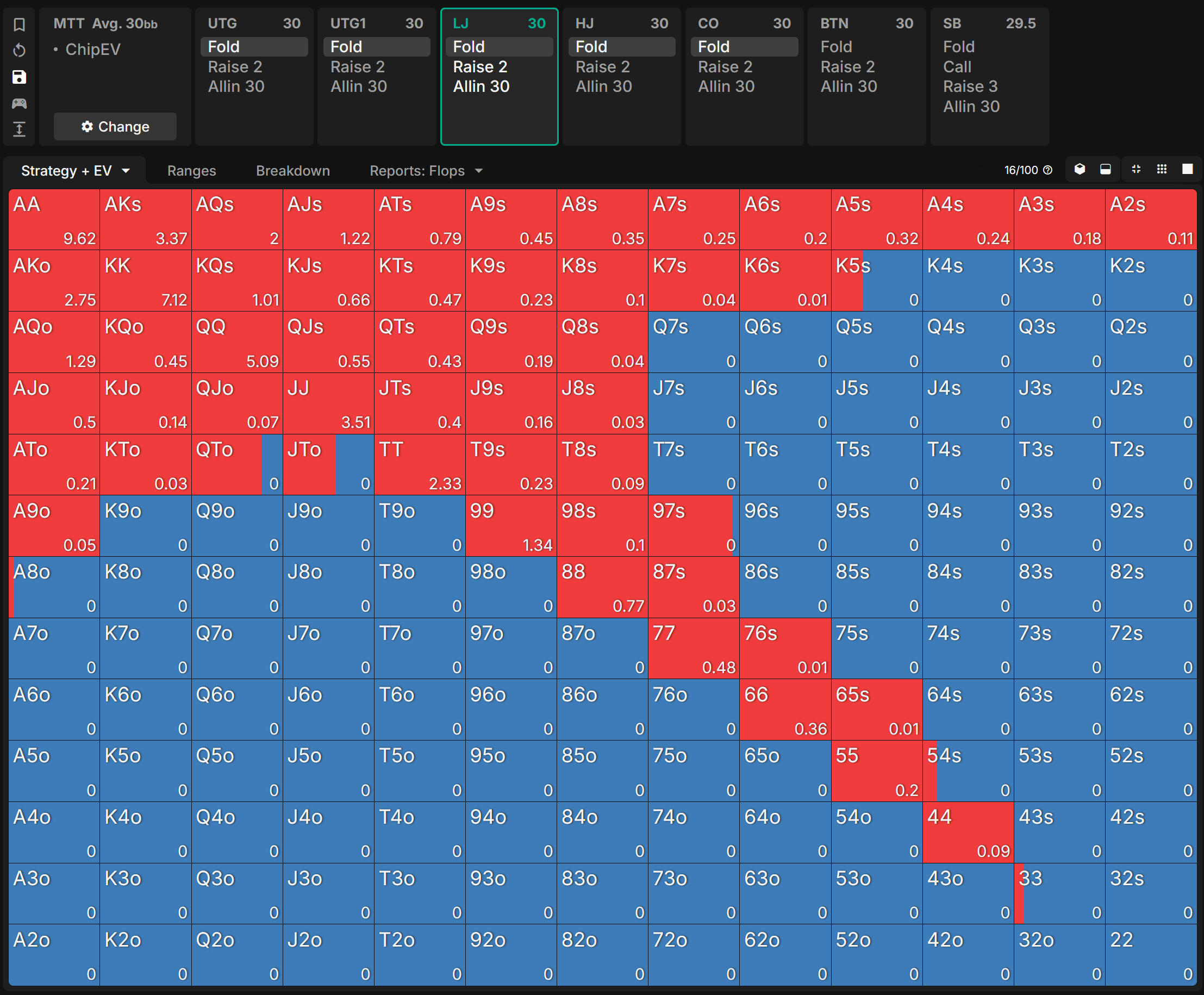
Substituting LJ range as an adjusted UTG open range vs a passive live field (~24.5%).
The table above is illustrative. Every adjustment starts from theory and shifts based on a specific observation. We never abandon the baseline entirely.
Live Tells: Calibrate Your Trust in Them
Live tells are real. Anyone who says otherwise is overcommitted to the theory side of things. But they are also dramatically over-weighted by players who have not done honest self-assessment about how reliably they read them.
The right framework depends on experience. Players who are new to live poker, or transitioning from a primarily online background, should focus almost entirely on one thing: not giving tells off themselves. Control your own patterns. Establish a consistent routine for looking at cards, making decisions, and placing bets. Once that is locked in, the secondary benefit is that you start to notice what inconsistent behaviour in others actually looks like, because you have a baseline of what consistent behaviour looks like.
Experienced live players already have intuitions they have built over years of play. Those intuitions are worth trusting, but not to the point of making massive adjustments on a single tell. The correct use of a tell is the same as the correct use of an exploit: a slight shift around the edges of your range. We pick up that the player in the CO is uncomfortable after checking the flop, so we barrel the turn at a slightly higher frequency. We notice that the SB has been placing bets with hesitation only when holding marginal made hands, so we call down slightly wider. We are not going from 40% to 100%. We are going from 40% to 45%.
The most actionable tells from weaker players fall into a few reliable patterns:
- Reaching for chips before the action reaches them. Usually signals a strong hand or a plan to raise. Slow down your aggression if you are planning a bluff.
- Sitting up or leaning forward. A player who suddenly becomes more alert and engaged often has a strong holding. Relaxed posture on later streets frequently indicates discomfort.
- Looking away quickly after betting. A classic strength tell in disguise. Players trying to appear disinterested after a bet are often strong, not weak.
- Checking their cards again when a flush or straight card arrives. Almost always means they are checking whether they hold that suit or a piece of the new board. Useful for ranging their hand.
- Bet sizing tells. Recreational players often bet larger with strong hands and smaller when they are bluffing or on a draw, reversing what GTO would suggest.
- Hesitation before betting. Especially on the river, a long pause followed by a bet from a recreational player often indicates genuine uncertainty, which correlates with a bluff or a marginal made hand rather than a strong one.
None of these are universal. Use them to make slight adjustments at the margin, not as the sole basis for a major call or fold.
Ego Wars at the Live Table
One of the most significant ways live poker differs from online is the personal dimension of aggression. Three-betting BTN in an online hand is mechanical. The other player is probably playing six other tables and will not remember the hand in twenty minutes. Three-betting the BTN three times in the same session at a live final table is a social act. Some players will respond logically. Many will not.
Two distinct dynamics emerge from this.
The player who goes on tilt against us. We have been picking up pots, three-betting aggressively, and running over the table. A specific player has decided that we will not get away with this. Their decisions are now driven by ego rather than hand strength. They call down lighter than they should. They three-bet us back in spots that do not make sense. They are making mistakes, and we should recognise that these mistakes are happening and adjust to them. When a player is clearly in a psychological war with us, their three-bet range is uncapped but their value range is narrower than usual. We can four-bet more freely with strong hands. We can also be aware that continuing to target them aggresively may be less productive than spreading the pressure around the table.
Our own ego. The harder and more important problem. When someone three-bets us repeatedly, opens over our opens, or outplays us in a big pot, the instinct is to fight back. That instinct is the enemy of good decisions. If someone is three-betting us too frequently, the correct response is to open tighter from positions where we are out of position to them, and four-bet more with the premium hands we do open. That is the logical adjustment. What we do not do is call their three-bets with marginal hands because we have decided we are going to play a pot with them. That is ego, not strategy.
The mental model that helps here is simple: picture the calmest, most unaffected player we have ever seen in a poker room. Every decision they make is based on the cards and the situation. Three-bets bounce off them. Losing a pot does not change how they assess the next one. That is the standard we hold ourselves to, regardless of what is happening around us.
Boredom Plays
Live poker is slow. A hand every two to three minutes, a shuffle, chip movement, floor decisions, split pots. If we are playing online we might squeeze 60-100 hands per hour at a single table. Live we see 20-25. That pace creates a psychological pressure that leads directly to one of the most common and most avoidable leaks in live tournaments: the boredom play.
A boredom play happens when a player who has not been involved in a pot for a while opens a hand purely because they are restless. They justify it to themselves: good image, nobody will believe I have it, I am due to play a hand. The actual reason is that they have been sitting there for 90 minutes and their brain wants action. The hand they chose, 9♥6♦ from UTG or J♣4♣ from HJ into a tight table, would never appear in their range under normal circumstances.
Boredom plays happen to us when we are not anchored to a clear framework. If we know our UTG range cold and know why it is what it is, the question of whether to open a given hand answers itself. We do not have to feel our way through it. The hand either fits the range for this table or it does not, and that evaluation takes two seconds. That anchor also removes the temptation to manufacture action.
Boredom plays happen at other tables and we can exploit them. The player who has not VPIPed in two hours and suddenly opens from early position is often on a boredom or frustration open. Their range is wider and less deliberate than normal. Against that player, we squeeze more, call in position with speculative hands, and give less credit to their continuation bets.
The most important habit that prevents both our own boredom plays and our failure to notice others making them is staying focused. Everything flows from focus.
Stay Off Your Phone
This is practical enough to say directly. Live poker gives us time between hands that does not exist online. That time is an opportunity for two very different things: gathering information, or disengaging from the table.
If we spend the time between hands watching the player two seats to our right, we might notice that they peek at their cards twice before folding. We might notice that they tighten up before an expected ICM jump. We might pick up that a certain player has not been involved in a pot for a long time and is starting to look frustrated. All of that information has value.
If we are on our phone reading something unrelated, we notice none of it. We look up when the action reaches us, play our hand, and look back down. We are essentially playing blind poker with an audience.
Staying focused does not mean staring at every player with intense suspicion. It means being present at the table, watching the hands we are not in, and building a picture of how everyone is playing. That picture informs every adjustment: the range tweaks, the tell calibration, the ego dynamic reads, the boredom play spotting. Without focus, none of those adjustments are available to us.
Key Takeaways
-
Theory is the baseline. Exploits are adjustments around it. Open slightly wider, barrel slightly more, adjust calling ranges at the margins based on specific observations. Never abandon the framework because the field is weak.
-
Tells and ego dynamics are real factors in live poker, but slight adjustments only. Over-folding because we think a player never bluffs, or getting into a personal war because someone three-bet us twice, are both ways of letting emotion override strategy.
-
Focus is the foundation of everything else. All live adjustments, from boredom play detection to tell reading to ego management, depend on staying present and watching the table when we are not in a hand.

Written by
PokerTournaments101
25 years playing mid-to-high stakes NLH and PLO across live and online. Poker industry veterans turned tournament grinders, tool builders, and writers.