Few topics in tournament poker generate as much discomfort as stalling. Players who do it apologise for it. Players who benefit from others doing it resent being in that position. Players who refuse to do it on principle quietly watch chips leave their stack over a long career.
The honest truth is that stalling at the bubble or near a pay jump is a positive EV action for the players in the right positions to do it. It is uncomfortable, it slows the game down, and it creates real friction at the table. It is also, for serious tournament players, a tool that cannot be left in the bag without accepting a significant long-run cost.
The Prisoner's Dilemma
The best way to understand why stalling persists is through the lens of game theory. Stalling is a textbook prisoner's dilemma.
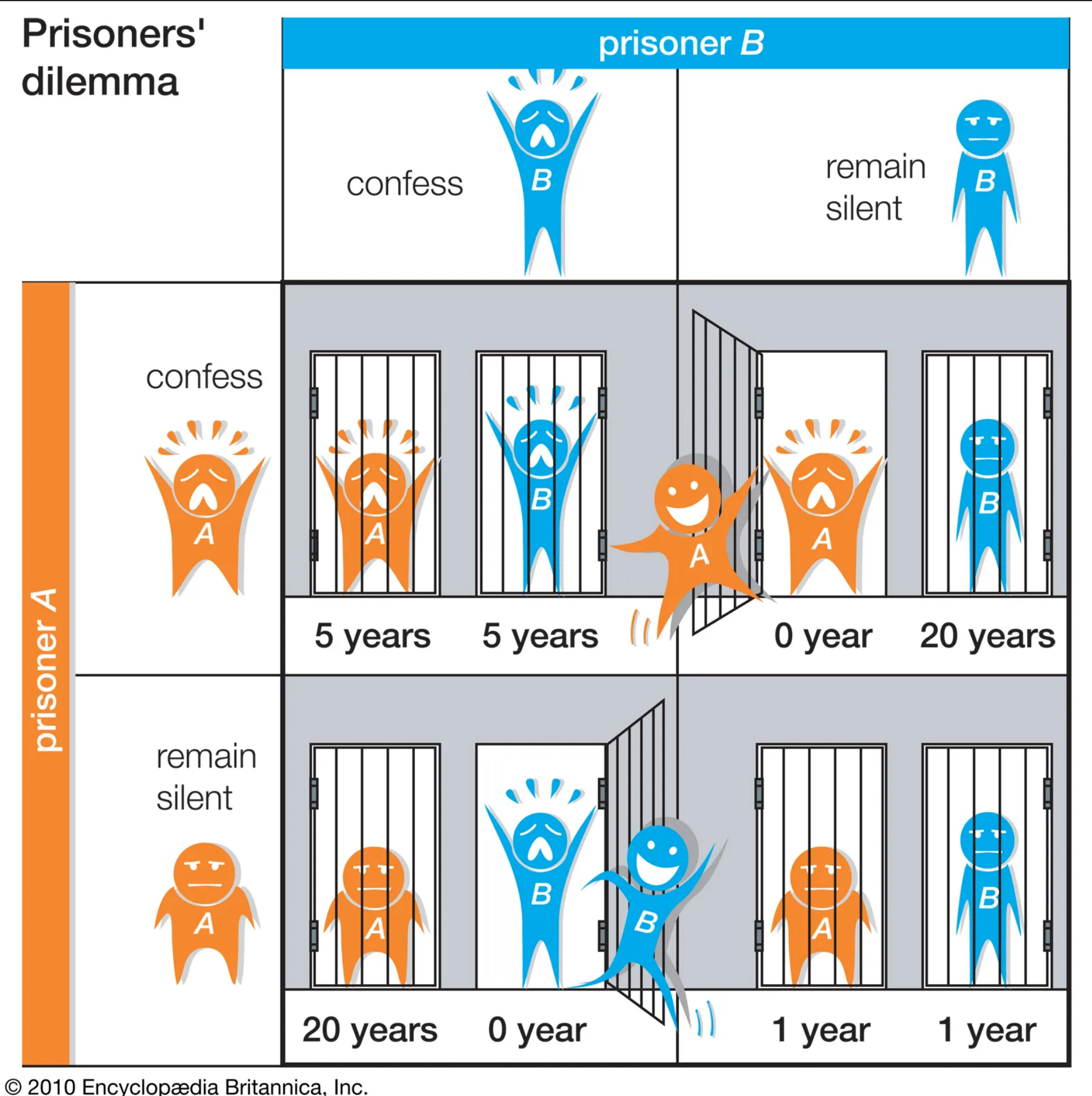
The prisoner's dilemma payoff matrix. Each player's best individual move leads to a result that is worse for everyone. Credit: Encyclopaedia Britannica.
If everyone at every table agreed not to stall, the game would run faster, bubble play would take 20 minutes instead of an hour and a half, and nobody would be stuck counting chips through a folded hand three times. Everyone would be better off. But that outcome is unstable. Any single player who breaks the agreement and stalls at their table gains EV at the expense of everyone who cooperated. The cooperative outcome collapses because the incentive to defect is too strong.
This plays out at every live tournament, every bubble, every money jump. Even players who find stalling distasteful end up doing it, because the alternative is donating EV to the players who are willing to do it. Over the last few years the average length of bubble play in major live events has increased noticeably as more players have internalised this logic.
In some high roller fields a genuine agreement to not stall occasionally forms, enforced by a small enough player pool where reputation matters and everyone knows each other. In a 500-player field, that agreement will never form. There are too many tables, too many anonymous entrants, and no mechanism to police it. Accept that stalling is part of the game at every level below super high rollers and plan accordingly.
When Stalling Creates the Most Value
Stalling matters most when there is a meaningful payout jump approaching and the chip counts at different tables create an asymmetric situation. The classic case is the money bubble: one or more players at another table are extremely short while our stack is safe or medium.
The logic is simple. If the short stack busts at another table before the next hand completes, we lock up a pay jump without risking chips. Every minute we can slow the game down is another minute that short stack is surviving with blind pressure on them. Our EV increases with each hand we can delay.
The situations where stalling has genuine value:
- On the money bubble with one or more short stacks at other tables who are close to blinding out
- Near a significant pay jump (final table bubble, top 3 spots, heads up) when another short stack is approaching zero
- In any spot where busting before the next player means a meaningful dollar difference
The situations where stalling does not help or actively hurts:
- When our own stack is extremely short and we need to play hands urgently
- When all remaining players have similar stacks and nobody is close to busting
- At a single-table final table where everyone sees exactly what is happening at all times
Stack Size and Stalling
The player for whom stalling creates the most value is the medium stack on the bubble. A short stack needs hands dealt to them quickly. A big stack faces no real ICM pressure and their situation does not change much if the bubble extends for another orbit. The medium stack is the one trying to lock up a pay jump without playing pots, and every hand that passes without a big stack decision is potentially that short stack at another table blinding closer to zero.
| Stack Size | Stalling Value | Why |
|---|---|---|
| Very short (below 10bb) | Low | Needs hands, not delays |
| Short-medium (10-20bb) | Moderate | Benefits from ICM locking in, but has enough chips to wait |
| Medium (20-40bb) | High | Classic stalling beneficiary, avoids risky pots while short stack bleeds |
| Big stack (chip leader) | Low-Moderate | Less ICM pressure, already in good shape regardless |
How to Stall in Practice
The mechanics of stalling do not require slow rolling or anything that crosses into outright rule violations. The most common approaches:
Count your stack before every decision. Regardless of how standard the action looks, take time to count your chips before deciding. This is within the rules at any live tournament and can extend each hand by 20-30 seconds at minimum.
Take full use of the shot clock. In timed events, use your full allocation before acting. Do not feel any pressure to act quickly when the clock is available.
Look at your cards slowly. Peel them back, look away, look again. Take time before acting even on hands we plan to fold immediately.
Ask for chip counts. Requesting a count of another player's stack is legitimate and adds time to any hand.
Use time cards wisely. If the event provides time extension cards, use them in situations where we would otherwise be pressured to act quickly.
None of these are deceptive in a way that misrepresents our hand. They are simply using available time. The discomfort comes from the fact that everyone at the table understands what is happening. That discomfort is real, and it is worth accepting.
The EV Obligation
This is the uncomfortable core of the argument. Our obligation at a poker table is to our own EV. When we sit down in a tournament, we are not playing for the enjoyment of our opponents or the pace of the game. We are playing to maximise our expected return from the field.
Refusing to stall in a situation where stalling is +EV is, in a real sense, donating money to the rest of the field. Over a year of tournament play, that adds up. Over a career, the cumulative cost of voluntarily declining to stall in spots that call for it can be significant.
The counterargument is that stalling makes the game worse for everyone and erodes the culture of the game. That argument is not wrong. But it runs into the prisoner's dilemma problem. We cannot opt out of stalling and have the outcome improve, because our opt-out does not cause others to opt out. It just costs us money while leaving the dynamic unchanged.
The practical resolution is to stall when the situation calls for it, accept that others will stall when they are in position to do so, and understand that everyone is making the individually rational decision even if the collective outcome is unfortunate.
Reading the Table When You Are the Target
When we are the one on the short stack with medium stacks at our table stalling against us, the dynamic reverses. We need hands dealt. We need to find a double-up before our stack disappears. The stalling at our table is costing us equity with every hand that passes.
There is limited recourse in this position. Calling the clock on players who have taken genuinely excessive time is legitimate. Asking the floor to enforce time limits is fair. Beyond that, accepting the situation and playing our best short-stack game is all we can do.
One adjustment: if we are very short and need to take a marginal shove spot, the stalling dynamic at our table might actually justify going slightly wider than normal. Our EV from surviving one more hand is lower than usual because another hand passing with no action is costly. The logic of waiting for a better spot weakens when stalling is compressing the number of hands remaining before we blind out entirely.
Key Takeaways
-
Stalling is individually rational even when it is collectively bad. No stable agreement not to stall will ever form at most field sizes. Declining to stall when the situation calls for it is a long-run cost that compounds over a career.
-
Medium stacks on the bubble benefit most. Enough chips to survive, motivated to let a short stack elsewhere blind out. When we are very short the dynamic reverses, we need hands, not delays.
-
The mechanics are simple and within the rules. Count chips, use the shot clock, ask for counts. Accept the friction, accept the looks, and move on.

Written by
PokerTournaments101
25 years playing mid-to-high stakes NLH and PLO across live and online. Poker industry veterans turned tournament grinders, tool builders, and writers.