Watch enough final table coverage from major events and a pattern emerges quickly. When you check the chip counts as players bag their stacks the night before a final table, the same names tend to sit in the top two or three spots. This is not purely because elite players run well. It is because they think about the tournament differently from about 20 players remaining onward, and that thinking produces a structural advantage that compounds dramatically once the final table begins.
The Prestige Trap
Most tournament players have a complicated relationship with the concept of making a final table. There is a real psychological pull to it, especially in high-profile events. Making the WSOP Main Event final table, or any final table at a major series, feels like an achievement worth protecting. Players want to say they made it. They want to make the post. They want the credential.
That pull is the source of one of the most expensive leaks in tournament poker.
Beginning roughly at the final two to three tables, players who are susceptible to this dynamic start making a specific error: they fold positive EV spots, use ICM as the justification, and tell themselves they are playing correctly. Sometimes the ICM justification is legitimate. Frequently it is not. It is a rationalisation for a decision that is really being driven by not wanting to bust before the feature table.
The cost is brutal and predictable. Players who do this end up collecting 7th through 9th place finishes at a rate that far exceeds what variance alone would produce. They make the final table. They just never do anything with it. They arrive short or middle-stacked, fold their way to a modest pay jump they could have exceeded by playing better earlier, and then tell themselves at least they made it.
One first place finish is worth more than six seventh place finishes in virtually every tournament structure. Playing not to bust before the final table produces the worst of both outcomes: no meaningful money, and no meaningful experience.
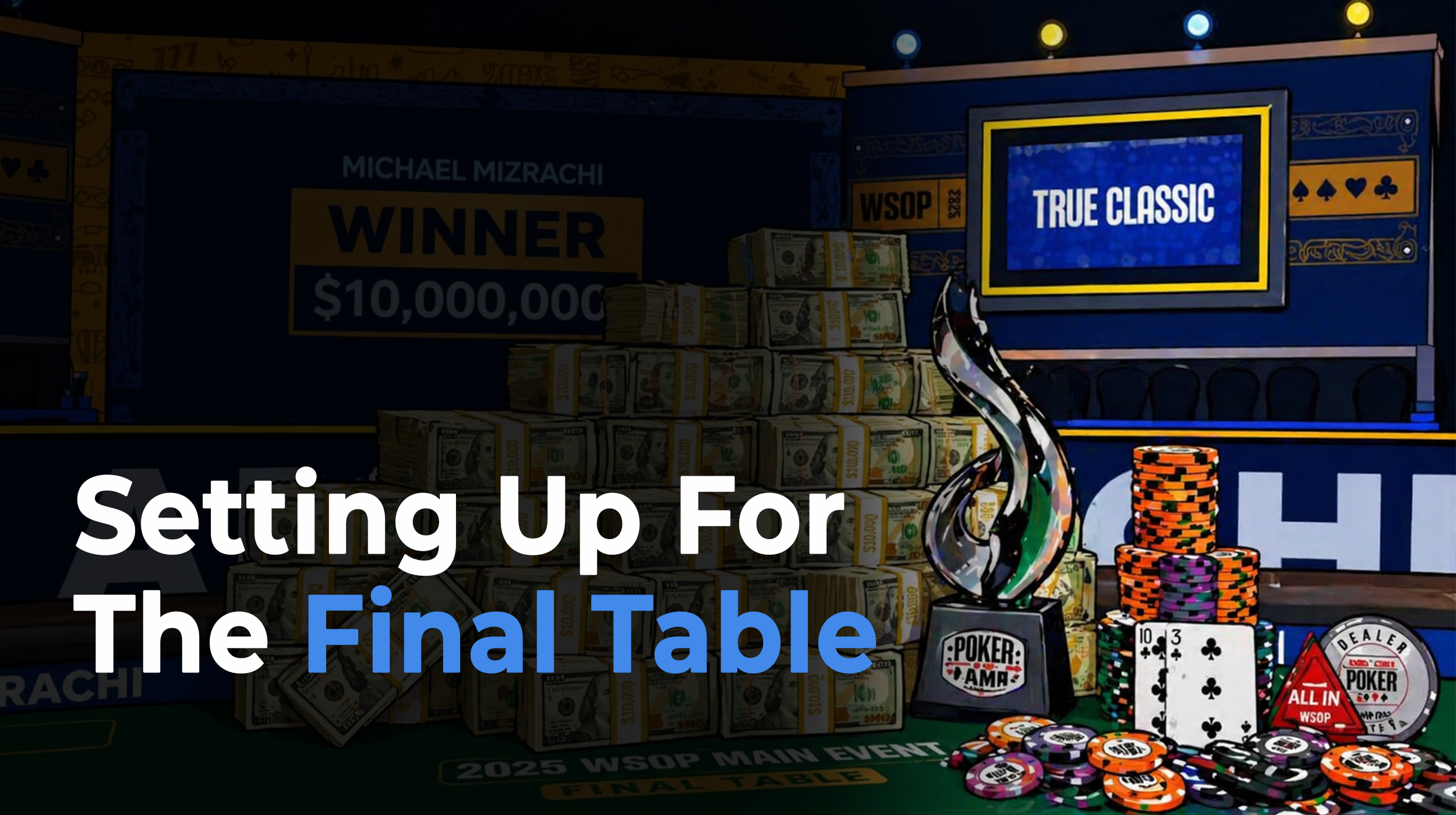
 2025 WSOP Main Event final table payouts: $10,000,000 for 1st place vs $1,500,000 for 7th. What's more probable six 7th place finishes or 1 victory?
What Chip Lead Actually Buys You
The structural value of arriving at a final table with a chip lead, or in the top two or three stacks, is not linear. It is multiplicative.
One of the most instructive final tables in recent memory for illustrating this is Joe McKeehen's run at the WSOP Main Event. McKeehen arrived as a significant chip leader and the dynamic that unfolded was almost textbook: the medium and short stacks, all of whom faced genuine and enormous ICM pressure, played extremely tight. That tightness allowed McKeehen to open nearly anything from nearly any position and collect blinds and antes without a showdown. He did not need to win big pots. He simply accumulated constantly while everyone else tried not to be the next person busting.
This is not a unique outcome. It is the normal outcome when a skilled player has a meaningful chip advantage at a final table. The structural squeeze on shorter stacks is that severe.
Here is why the squeeze works. Consider the player sitting 5th in chips at an 8-handed final table. They open A♣Q♦ from the CO for 25bb. The chip leader 3-bets. Four players sit below the CO in chips. What are the options?
- Calling puts us at risk of building a big pot out of position against the player with the most chips and the most freedom
- 4-bet shoving risks elimination in a spot where four players would leapfrog us if we bust, costing us multiple pay jumps
- Folding concedes the pot and chips we already invested
None of these options are comfortable. The chip leader has put us in a situation where even a premium hand in a favourable position becomes a genuine problem. We did not make a mistake opening. We were simply in the wrong structural position. The chip leader can manufacture these situations at will, hand after hand, until we either make a significant error or blind down to a point where our decisions no longer matter.
The ICM Squeeze in Numbers
The mathematical pressure on medium and short stacks at a final table is extreme enough that most players underestimate it, even those who have studied ICM thoroughly.
| Stack Position | Shoving Freedom | Calling Range | Structural Role |
|---|---|---|---|
| Chip leader (1st) | Extremely wide | Chip EV, less ICM constraint | Apply pressure, accumulate without showdown |
| 2nd-3rd | Wide, some constraint | Moderately tight | Selective aggression, avoid the chip leader |
| 4th-6th | Constrained | Very tight | Survival-focused, hard to build chips |
| 7th-9th (short) | Push/fold territory | Extremely tight | Waiting for a spot to double, limited agency |
The chip leader essentially gets to play a different game from everyone else at the table. While stacks in 4th through 9th are all trying not to make the mistake that ends their tournament, the chip leader is printing chips. They open, everyone folds. They 3-bet a reasonable open, the opener folds. Hand after hand, the chip lead grows without risk.
When the Tightening Starts
The most dangerous phase for this dynamic is when approximately 11-13 players remain. This is where the final table becomes close enough to taste. Players who have been playing correctly all day suddenly smell the feature table. The grip tightens. Opens that would have been standard an hour ago get folded. 3-bets that were clearly profitable stop happening.
Do not do this. Play good poker at 13 remaining the same way we played it at 50 remaining. The only information that should change our opening frequencies and aggression levels is what is actually happening at our table: who is playing tight, who is folding to 3-bets, where the dead money is. Those are legitimate reasons to adjust. The proximity of the final table is not.
The player who arrives at the final table 5th in chips having tightened up through the final two tables should have arrived 2nd or 3rd. That difference in chip position is the difference between genuine opportunities to win the tournament and a session of folding until the blinds make the decision for us.
Heads Up Is Where It Compounds
There is a secondary reason why chip positioning matters beyond the structural squeeze: the heads up phase.
Most tournament players are genuinely bad at heads up poker. This is not an insult, it is simply a product of where most study time goes. Heads up is infrequently practiced, poorly understood, and easy to avoid by accepting a chop deal. And almost everyone takes the chop.
A player with real heads up ability who gets to the final two or three with a significant chip advantage is essentially playing a private high-stakes heads up match against an opponent who would not normally play them at those stakes. The opponent knows they are likely outmatched. They chop. The skilled player who knows they have an edge and declines the chop has an enormous positive expected value situation.
The math is straightforward. The difference between first and second in most major tournament payout structures is the single largest pay jump in the event. That gap is also the place where heads up skill and chip position compound the most aggressively. Getting to that situation with a meaningful chip advantage, against an opponent with limited heads up experience, is one of the highest ROI scenarios available in tournament poker.
Players who know they have a genuine heads up edge should be thinking about this actively as they play through the final two or three tables. Not recklessly, not by punting chips, but by staying aggressive enough to give themselves the best possible position when the final table begins.
The Conversion Mindset
The practical shift this requires is in how we define a successful tournament. A 7th place finish at a WSOP bracelet event is not a meaningful achievement when it comes from tightening up at 12 remaining to protect a final table appearance. It is a result that cost us chips and opportunities while producing a payout that does not reflect the skill and time invested.
A successful deep run means:
- Staying aggressive through the final two to three tables when positive EV spots are available
- Arriving at the final table top three in chips whenever possible
- Refusing to use ICM as a rationalisation for folds that are actually driven by prestige concerns
- Treating heads up situations as opportunities rather than things to escape through a chop deal
The players who convert deep tournament runs into first place finishes consistently are not just better at poker. They are better at targeting the structural position that makes winning easy. Chip lead at the final table is that position. Everything we do in the final stages of a tournament should be oriented toward acquiring it.
Key Takeaways
-
Do not tighten up to make the final table. The prestige of a final table appearance is not worth sacrificing the chip position needed to actually win money there. Seventh through ninth is the worst outcome: no real money, no real credential, and a result that could have been avoided by playing better earlier.
-
Chip lead at the final table is a structural multiplier, not just an advantage. The chip leader plays a fundamentally different game from every other stack. Medium and short stacks are squeezed by ICM into extreme passivity, which the chip leader exploits continuously and without showdown.
-
Heads up skill converts chip position into maximum ROI. The biggest pay jump in any tournament is first versus second. Players who can play heads up well should resist chop deals and treat those situations as high-value edges that are worth getting to.

Written by
PokerTournaments101
25 years playing mid-to-high stakes NLH and PLO across live and online. Poker industry veterans turned tournament grinders, tool builders, and writers.