Progressive knockout tournaments are now among the most popular formats in both live and online poker. They are louder, more action-packed, and more profitable for players who understand how the bounty math changes their decisions. They also punish players who treat them like regular tournaments.
The core problem is this: most players either ignore bounties entirely or overweight them. Both are expensive mistakes. This guide gives you the framework to price bounties correctly, adjust your ranges accordingly, and use the Bounty Hunting Calculator to get exact numbers for any real-time decision.
What Is a Progressive Knockout (PKO) Tournament?
In a standard tournament, the entire buy-in contributes to a single prize pool. In a PKO tournament, the buy-in is split between two pools: a regular prize pool and a bounty pool. Every player enters with a bounty on their head.
When you knock a player out:
- You receive 50% of their bounty immediately as a cash prize
- The other 50% is added to your own bounty, making you worth more to the next person who eliminates you
This is what makes the format progressive. Bounties compound over time. A player who has made several eliminations might be worth $400 to knock out. A player who just sat down in the $500 buy-in is worth $125. These are completely different spots from a mathematical standpoint, and your calling ranges should reflect that.
How PKO Buy-ins Are Structured
In a typical 50-50 PKO with a $500 buy-in (plus rake), the money splits like this:
| Pool | Allocation | Example ($500 buy-in) |
|---|---|---|
| Regular prize pool | 50% of buy-in | $250 |
| Bounty pool | 50% of buy-in | $250 |
| Starting bounty on your head | 50% of bounty allocation | $125 |
So every player starts with a $125 bounty displayed on their name. When you eliminate someone, you collect $125 in cash (50% of $250) and $125 gets added to your own bounty. This other 50% cascades forward rather than disappearing and increases your own bounty.
This structure means the total bounty pool is never destroyed. It just concentrates into fewer players as eliminations stack up, which is why bounties are worth more later in the tournament.
The Most Important Concept: Bounty Chip Equivalence
To make correct decisions in a PKO, you need to convert a cash bounty into chip equity. A $250 bounty is not worth $250 in chips. It is worth whatever number of chips gives you the same expected value as the cash prize when you factor in your tournament equity.
The general principle is that a bounty acts as extra chips in the pot. When you are considering a call and a bounty is at stake, the effective pot is larger than the chips you can see. This means you need less equity to make the call profitable.
The relationship is not linear. The chip value of a bounty grows as the tournament progresses, because:
- Bounties accumulate into fewer stacks as players bust out
- The average stack is larger relative to the starting stack, so the dollar value of each chip shifts
- Near the final table, a bounty can be worth nearly twice its early-tournament chip equivalent
This is captured in what the Bounty Hunting Calculator calls the F(ield)-factor, which ranges from 0.250 at the very start of a tournament to 0.448 at the final table. More on how this works in the calculator section below.
When to Widen Your Calls
The bounty changes one thing in your decision process: it adds value to the right side of the equation when you are calling. It does not change the value of folding, it does not change what happens if you lose the hand, and it does not change ICM pressure.
What it does is make marginal calls that would be losing in a regular tournament into winning calls in a PKO.
Sizing the Extra Value
The numbers below are run through the Bounty Hunting Calculator using a fixed spot: facing a bet of 10bb with 15bb already in the middle. $500 buy-in, $125 starting bounty, 10,000-chip starting stack (1 BB = 1,000 chips).
Standard break-even with no bounty: 10,000 / (15,000 + 10,000) = 40.0%
Effect of bounty size on break-even equity (50% field remaining, F = 0.288):
| Villain's Bounty | Multiple | Chip Equivalent (G) | Break-Even Equity | Reduction |
|---|---|---|---|---|
| None (regular MTT) | — | 0 | 40.0% | — |
| $125 (starting bounty) | 1x | 2,880 | 35.9% | −4.1% |
| $250 | 2x | 5,760 | 32.5% | −7.5% |
| $500 | 4x | 11,520 | 27.4% | −12.6% |
| $1,000 | 8x | 23,040 | 20.8% | −19.2% |
A player sitting on 8x the starting bounty effectively adds over two full pot sizes of chip equity to the call. The same hand requiring 40% equity against a fresh opponent requires only 20.8% against them.
Using the Range vs Range Equity Calculator we can see that a hand like A♦6♠ is calling 100% of the time vs a range of TT+ AKo AKs.
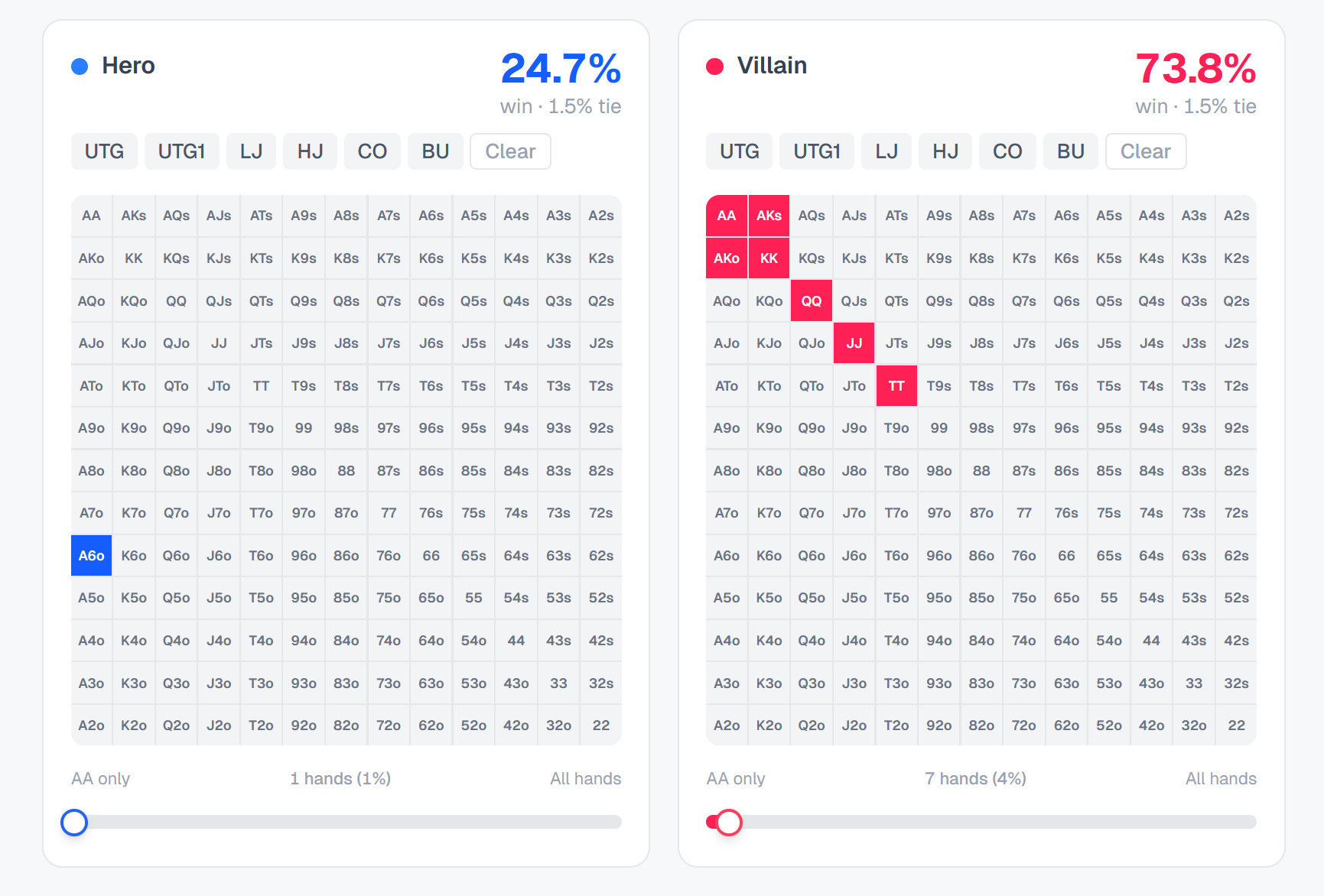
Ad 6s versus a tight value-shove range of TT+ AKo AKs. Against this range, A6o has roughly 34% equity — well short of the 40% needed in a standard tournament, but comfortably above the 20.8% required when the villain sits on an 8x bounty at mid-stage.
The tournament stage also shifts the number, but more gradually. The biggest lever is always the size of the bounty relative to the starting bounty.
Effect of tournament stage on break-even equity (same spot, 4x bounty = $500):
| Field Remaining | Stage | F-Factor | Chip Equivalent (G) | Break-Even Equity |
|---|---|---|---|---|
| 100% | Early stages | 0.250 | 10,000 | 28.6% |
| 50% | Mid-stage | 0.288 | 11,520 | 27.4% |
| 10% | In the money | 0.365 | 14,600 | 25.3% |
| 1% | Final table | 0.448 | 17,920 | 23.3% |
The stage effect compounds when combined with a large bounty. A player who entered with $125 and accumulated to $1,000 is worth calling at the final table with as little as 16.4% equity in this same 10bb/25bb spot. Of course, this has to be balanced out with the extreme ICM considerations at a final table.
What the Bounty Hunting Calculator Actually Does
The Bounty Hunting Calculator converts all of these variables into one number: the break-even equity needed to call in your specific spot.
Here is the math the calculator runs:
Standard tournament break-even equity:
Equity needed = Call / (Pot + Call)
PKO break-even equity:
G = (Villain's Bounty / Starting Bounty) × Starting Stack × F-factor
Equity needed = Call / (Pot + Call + G)
G is the chip-equivalent value of the bounty. Adding G to the denominator makes the effective pot larger, which lowers the break-even percentage.
The F-Factor Explained
The F-factor is what makes the calculator accurate rather than approximate. It accounts for the tournament stage by measuring what percentage of the original field is still playing.
| Field Remaining | F-factor | Stage |
|---|---|---|
| 100% | 0.250 | Early stages |
| 75% | 0.265 | Still early |
| 50% | 0.288 | Mid-stage |
| 25% | 0.324 | Bubble approaching |
| 10% | 0.365 | In the money |
| 5% | 0.390 | Final 3 tables |
| 1% | 0.448 | Final table |
At 100% of the field remaining, a bounty worth 1x the starting bounty adds 0.250 of the starting stack in chip equity. At the final table, that same bounty is now worth 0.448 of the starting stack. Nearly twice as much.
Why does a smaller field make each bounty worth more?
The answer comes down to a mismatch between how chips and bounties scale as players bust out.
Chips are a closed system. The total chip count in the tournament never changes: when a player busts, every chip they held moves to another stack. The chips themselves carry no inherent dollar value, their value comes from representing a claim on the prize pool, spread across all remaining stacks.
Bounties work differently. Each time a player is eliminated, half their bounty is paid out in cash and half is added to the eliminator's own head. The rest of the bounty money is redistributed and concentrates. Start with 100 players each carrying a $125 bounty. By the time 90 players have busted, the surviving 10 have absorbed half of every bounty that was paid out along the way.
When you convert a cash bounty into chip equity, you are asking: how many chips added to the pot would give the same expected return as this dollar prize? Because the prize pool is fixed and the average surviving stack has grown considerably, each chip at a late stage represents a larger fraction of an individual player's holdings. The same $250 bounty prize buys proportionally more chip equity at the final table than it does in level one, because chips are worth more relative to average stack depth. That growing ratio is what the F-factor captures, stepping from 0.250 early to 0.448 at the final table.
The practical implication: the field slider matters most at the extremes. A player with a big bounty is worth calling much more widely in the last three tables than they were in the first hour. The calculator handles the exact conversion; the intuition is that late-tournament bounties punch above their dollar weight.
This is why bounty hunting is so profitable at final tables, and also why you should not wildly overfit your preflop ranges to bounties in the first level of a tournament.
A Worked Example
Setup: $500 buy-in PKO. Starting stack 10,000 chips. Starting bounty $125.
Situation: You are in the mid-stages of the tournament (50% of the field remaining). A player with a $375 bounty (3x starting) shoves 8,000 chips into a pot of 11,500. You need to call 8,000. Both stacks are at risk.
Without the bounty:
- Break-even equity = 8,000 / (11,500 + 8,000 + 8,000) = 8,000 / 27,500 = 29.1%
With the bounty (using the calculator):
- F at 50% field = 0.288
- G = (375 / 125) × 10,000 × 0.288 = 3 × 10,000 × 0.288 = 8,640 chips
- Break-even equity = 8,000 / (27,500 + 8,640) = 8,000 / 36,140 = 22.1%
A call that requires 29.1% equity in a regular tournament requires only 22.1% here. You can profitably call with a hand that is a 22/78 underdog against the villain's range.
You can verify this by entering: buy-in $500, starting stack 10,000, villain's bounty $375, starting bounty $125, pot 11,500, call 8,000, field 50%. The calculator shows the equity requirement instantly.
How to Use the Calculator in Real Time
You will not always have time to calculate precisely during a hand. The goal is to internalize the framework well enough that you can approximate on the fly, then use the calculator away from the table to study common stack configurations at your regular buy-in level.
Step 1: Enter your tournament settings once. Buy-in, starting stack, and starting bounty do not change hand to hand. The calculator saves these in your browser so you only need to enter them once per session.
Step 2: Update the villain's bounty. This is the key variable. How many times is their bounty relative to the starting bounty? A $500 villain in a $125-starting-bounty tournament is 4x. That is meaningful.
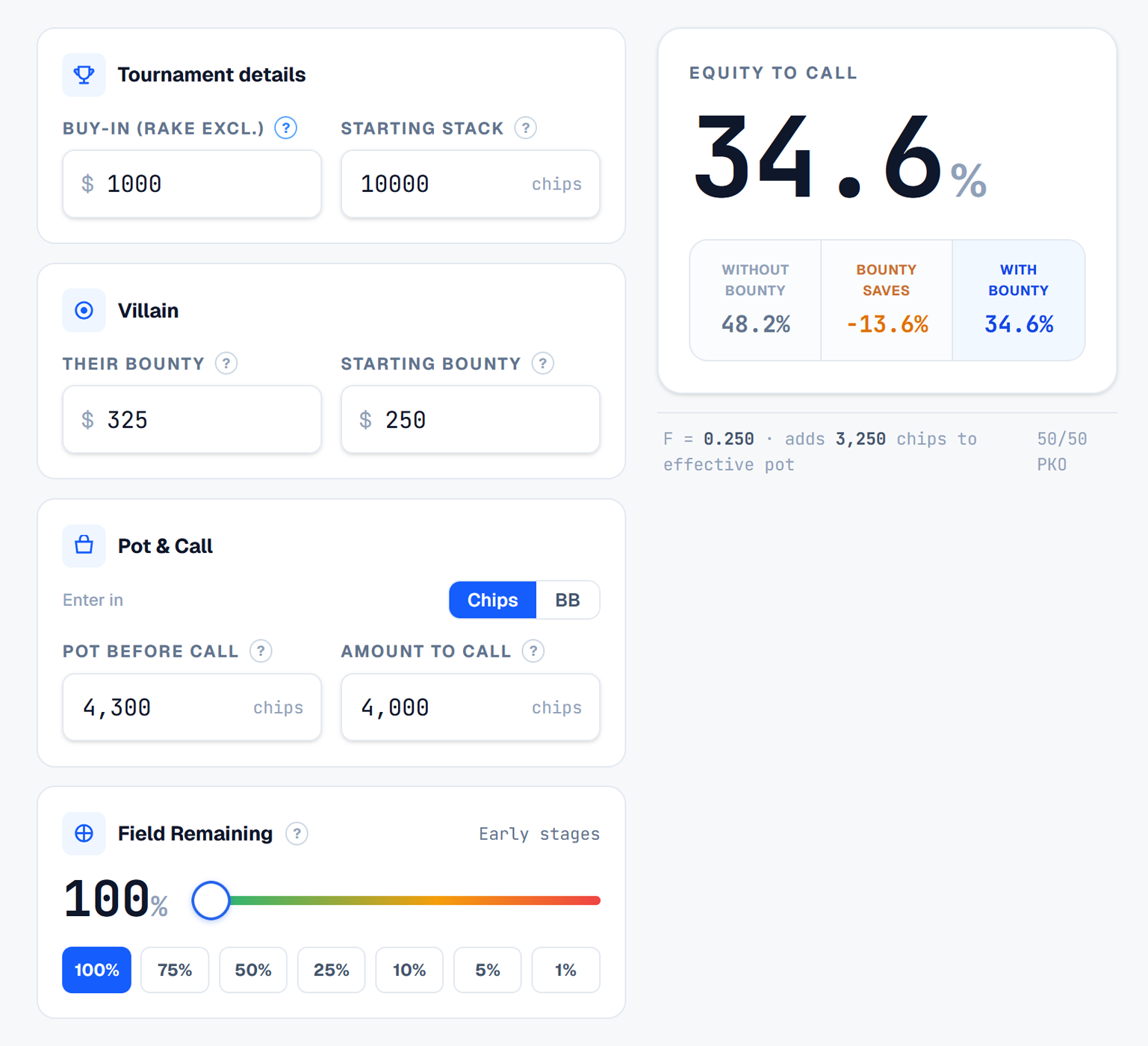
The calculator updates instantly as you type. The result panel shows break-even equity without the bounty, how much the bounty reduces that figure, and the final equity needed to call.
Step 3: Set field remaining. You do not need to be precise. The difference between 48% and 52% is negligible. Use the nearest preset. The biggest accuracy gains come from using the right ballpark: early stages versus final table.
Step 4: Enter the pot and call size. You can enter in chips or big blinds, whichever you track more easily in game.
Step 5: Read the result. The calculator shows three numbers: break-even equity without the bounty, the reduction the bounty provides, and your actual break-even equity with the bounty. Compare this to your estimated hand equity and make the decision.
Strategic Adjustments by Tournament Stage
Early Stages (100-80% field remaining)
Bounties are small. The F-factor is at its minimum. The chip-equivalent of a 1x bounty is 2,500 chips on a 10,000-chip starting stack. That is significant in isolation, but you also have deep effective stacks relative to blinds, which means the pot is small and the extra chip equity matters less proportionally.
The adjustment at this stage still requires you to open wider and play a wider range of hands, but do not dramatically deviate from standard tournament ranges when calling versus post-flop all-ins.
Mid-Stage to Bubble (50-25% field remaining)
This is where PKO strategy diverges most sharply from regular MTT strategy. Bounties have started accumulating. Players who are running well may have 3x-5x the starting bounty. ICM pressure from the bubble interacts with bounty value in ways that require both factors to be considered simultaneously.
The general rule: against a player with a large bounty, the equity reduction from the bounty partially offsets the ICM cost of losing your stack. Do not overcorrect. You are not trying to call every shove because the bounty is big. You are trying to find the spots where the bounty tips a marginal situation into a positive one.
In the Money and Deep Runs (10% field and below)
Bounties are at their peak chip value. The F-factor is now 0.365 or higher. A player with 4x the starting bounty is adding 0.365 × 4 × starting stack in chip equity to the pot. At a short final table this can be a massive proportion of the effective pot.
This is also where the interaction with ICM becomes most complex. Calling for a bounty might be correct in isolation but negative when you factor in the pay jump structure. The calculator gives you the equity adjustment from the bounty but does not account for ICM. For final table spots with major pay jumps, you need to mentally combine both effects.
Common PKO Mistakes
Chasing Bounties Out of Position
A large bounty is not a reason to play poorly. If you have to play a marginal hand out of position with a short stack behind you and a pay jump looming, the bounty math does not save you. Only use the equity reduction as a reason to act differently when the other factors are approximately neutral.
Forgetting Your Own Bounty
Your own bounty grows every time you make an elimination. This is real money that other players are incentivised to call off against you with wider ranges. When you have a large bounty, expect to be called by hands that would fold in a regular tournament. Adjust your bluffing frequency downward and your value-betting threshold upward.
Applying PKO Logic to Spots Where You Cannot Win the Bounty
You can only win a bounty by eliminating a player. If the pot you are in is not all-in, no bounty is at stake. Do not adjust your calling range for a bounty in a situation where the villain has chips behind.
Treating All Bounties Equally Regardless of Stage
A $250 bounty early in a $500 tournament and a $250 bounty at the final table are not the same thing. The F-factor makes the final table bounty worth roughly 80% more in chip-equivalent terms (but remember losing your chips at the final table can significantly outweigh the gain of collecting a bounty). Use the field remaining slider and the result changes meaningfully.
Putting It Together
PKO tournaments reward players who do two things well: correctly price bounties into calling decisions, and avoid being lured into -EV spots just because a bounty is on the table.
The Bounty Hunting Calculator removes the guesswork. Enter the villain's bounty, the pot, the call, and where you are in the field. The calculator converts the bounty into chip equity, adds it to the effective pot, and gives you the exact percentage you need to profitably call. Against a 4x bounty at the final table, that number can be 10-15 percentage points lower than standard pot odds.
Study your common spots off the table. Know what a 2x bounty is worth at 50% field, what a 4x is worth at 10% field, and what your standard break-even equity is at the stack depths you play most. When those situations come up in real time, you will already know whether to call.

Written by
PokerTournaments101
25 years playing mid-to-high stakes NLH and PLO across live and online. Poker industry veterans turned tournament grinders, tool builders, and writers.